How to Plan a Household Move: A Step-by-Step Moving Guide
Learn how to plan a household move in the right order, from choosing your moving method and building a budget to packing, moving day, and settling into your new home.
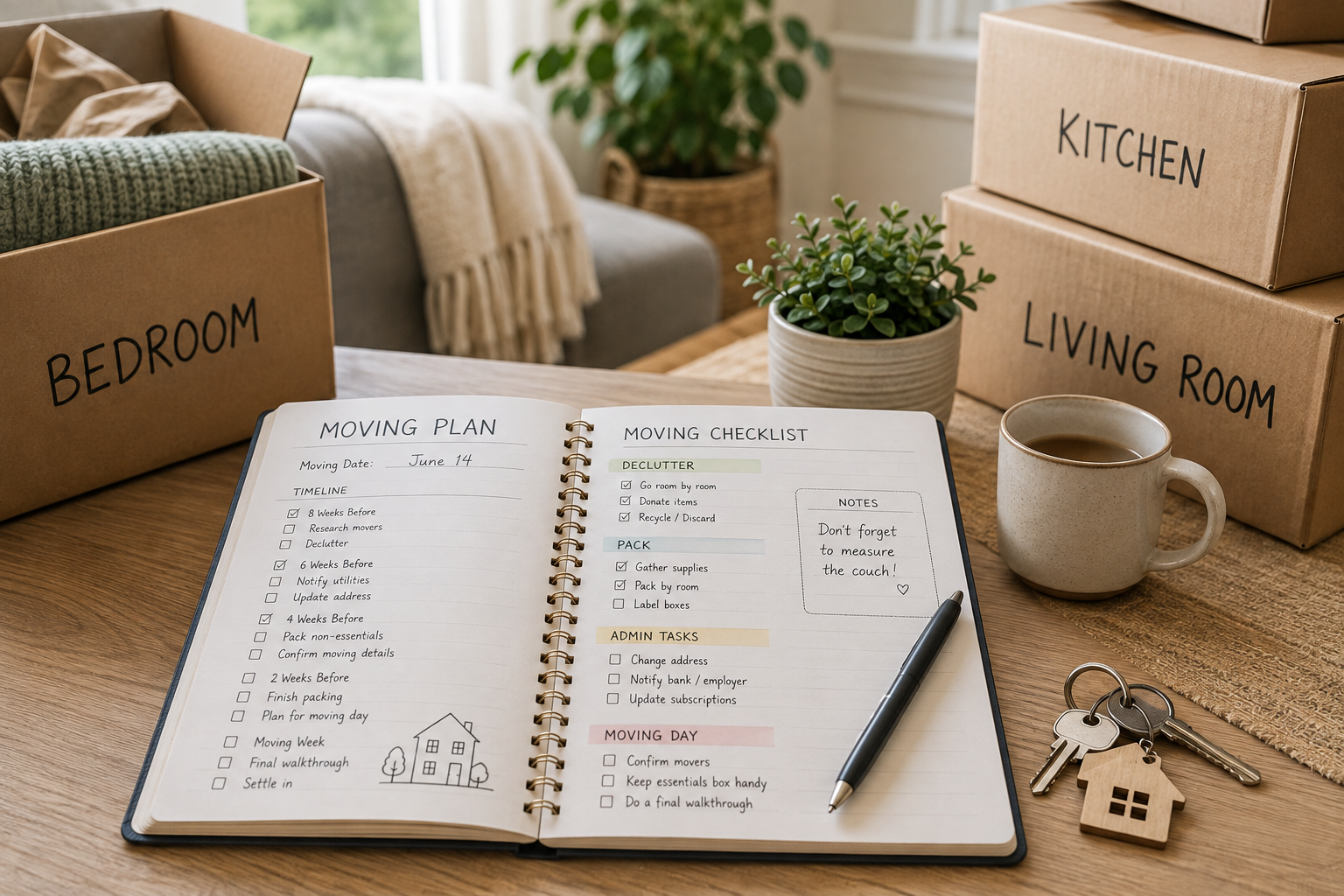
Planning a household move becomes much easier when you stop treating it as one enormous project.
A move is really a series of connected decisions. Your moving date affects your timeline. Your moving method affects your budget. The amount of stuff you’re taking affects the size of the truck or the estimate from a moving company. Your packing plan affects moving day. And decisions you make before leaving your current home can determine how smoothly you settle into the next one.
The goal, then, isn’t simply to make a very long moving checklist.
It’s to put the work in the right order.
This guide walks through the major stages of planning a U.S. household move, whether you’re moving yourself, hiring professional movers, or combining the two approaches.
Start With the Facts That Define Your Move
The amount of preparation time available can affect nearly every later decision. Learn when to start planning a move based on the household, moving distance, schedule, and complexity of the relocation. Before booking anything or buying packing supplies, write down the basic facts of the move.
One of the best early planning steps is reducing what the household needs to move. Use this guide to decide what to declutter before moving, before estimating supplies, truck space, labor, or storage.
Start with:
- your expected moving date;
- your current and new locations;
- whether the move is local, intrastate, or interstate;
- the approximate size of your household;
- who is moving with you;
- whether children or pets require additional arrangements;
- whether you expect to move yourself, hire movers, or use a combination;
- important deadlines connected with a lease, closing, job, school, or travel.
Some details may still be uncertain. That’s fine.
The purpose is to separate what you already know from what still needs a decision. Those unresolved decisions become the first items on your moving plan.
Step 1: Set Your Moving Date and Work Backward
Once the moving date is known, you can build a moving timeline backward from moving day to assign realistic deadlines to each major task. Your moving date is the anchor for almost everything else.
Once you have a target date, work backward and assign deadlines to major tasks such as:
- choosing your moving method;
- requesting moving estimates or reserving transportation;
- decluttering;
- gathering packing supplies;
- beginning nonessential packing;
- transferring or starting utilities;
- changing your address;
- packing most of the home;
- confirming moving-day arrangements;
- preparing essentials for the trip and first night.
You don’t need to predict every task perfectly on day one. A moving timeline should be a working schedule that becomes more detailed as the move approaches.
If your moving date changes, update the dependent tasks rather than trying to follow an obsolete schedule.
For a week-by-week version of this process, follow the eight-week moving timeline from early preparation through moving day.
How early should you begin?
There isn’t one correct lead time for every household.
A large interstate move with professional movers may require more advance coordination than a small local move. School schedules, lease dates, home closings, work responsibilities, accessibility needs, pets, storage, and travel can also change the timeline.
If you have plenty of notice, use it. Early planning gives you more room to compare options and spread the workload across smaller sessions.
If your move is approaching quickly, don’t try to recreate a perfect long-range schedule. Prioritize the decisions that affect everything else.
A written schedule prevents major tasks from collecting in the final week. Follow this 8-week moving timeline when you have enough lead time, or compress the sequence carefully if your moving date is closer.
Step 2: Decide How You Will Move
One of the earliest decisions is who will handle the physical move.
Most household moves fall into three broad approaches.
DIY move
With a DIY move, you handle most of the work yourself. That may include packing, loading, transportation, unloading, and coordinating helpers.
A DIY move can give you more control, but it also means taking responsibility for equipment, labor, transportation, loading, timing, and physical workload.
Professional movers
Professional movers may handle transportation alone or provide additional services such as packing and unpacking, depending on the company and services purchased.
If you’re hiring a company for an interstate household-goods move, consumer protection deserves a place in your planning process.
The Federal Motor Carrier Safety Administration advises consumers to research movers or brokers, understand contract terms, and review the required consumer information provided for interstate moves. Interstate movers must offer specific liability options, and federal rules apply to household-goods carriers operating in interstate commerce.
Don’t choose an interstate mover solely from an advertisement or an attractive quote. Verify the company and understand what you’re agreeing to before signing.
Hybrid move
A hybrid move divides the work.
For example, you might pack your belongings yourself but hire professionals for loading and transportation. Or you might rent transportation while hiring labor at one or both ends.
The right method depends on your household, budget, time, physical capabilities, belongings, distance, and tolerance for coordinating the work.
Make this decision early because it affects many of the steps that follow.
If professional help is part of your plan, evaluate several providers before reserving a date. Use this checklist of what to compare before choosing a moving company so the decision is based on more than the lowest estimate.
Step 3: Build a Realistic Moving Budget
A useful moving budget includes more than the headline price of a truck rental or moving company.
Before making deposits or purchasing supplies, create a moving budget that separates estimated costs, confirmed expenses, payments, and contingency funds.
Create categories for expenses that may apply to your move, such as:
- professional moving services;
- truck or trailer rental;
- hired moving labor;
- packing materials;
- storage;
- transportation and travel;
- lodging;
- parking or access arrangements;
- utility setup or deposits where applicable;
- cleaning;
- pet-related arrangements;
- childcare;
- meals during the transition;
- replacement household necessities;
- other move-specific costs.
Separate confirmed costs from estimates.
Review the major moving expenses to plan for so transportation, packing, travel, service changes, and arrival costs are represented in the budget.
As actual amounts become known, replace your estimates. Keep receipts and moving records together so you can see what has been paid, what remains due, and where the budget is changing.
Don’t assume household moving expenses are generally deductible on your federal income tax return. Federal tax treatment is limited and can change. Check current IRS guidance or consult a qualified tax professional if the tax treatment of your move matters to you.
After setting the spending ceiling, review the expense categories that may apply before moving day and assign each one a documented amount or temporary allowance.
A contingency amount can help, but it is also useful to identify moving costs people often forget before finalizing the budget.
Step 4: Create One Master Moving Timeline
A moving checklist tells you what needs doing.
A timeline tells you when it needs doing.
Those aren’t quite the same thing.
Instead of keeping disconnected lists on your phone, refrigerator, email, and scraps of paper, build one master timeline.
A simple structure might include:
Early planning: moving method, estimates, budget, inventory, decluttering and major reservations.
Middle stage: packing, household administration, utilities, address changes and arrangements for children, pets, travel or storage.
Final weeks: finish packing, confirm reservations, prepare documents and essentials, clean, and complete remaining administrative tasks.
Final days: verify arrangements, prepare items that stay with you, finish essential-room packing and get both the household and home ready for moving day.
Moving day: supervise loading, protect important records and valuables, complete the final walkthrough, travel and manage delivery.
After arrival: handle immediate safety and utility needs, unpack essential areas, and continue address and account updates.
The exact dates will differ. What matters is having one place where the deadlines live.
If the usual preparation period is not available, this guide to planning a move in four weeks identifies the decisions and deadlines that generally need attention first.
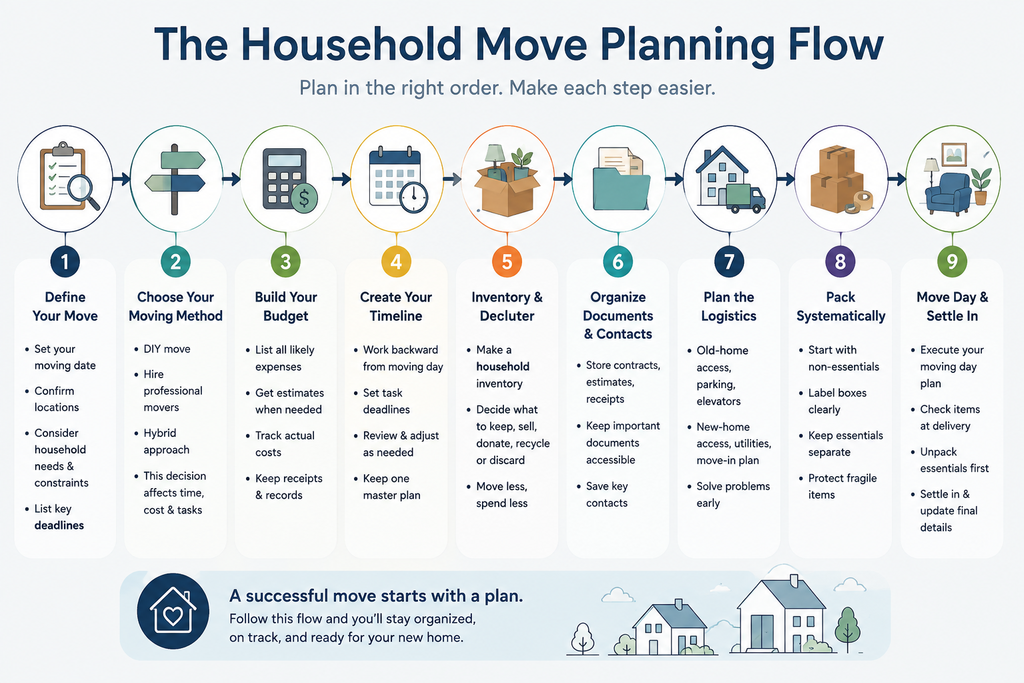
For an even shorter schedule, use the priority checklist for moving in two weeks to separate immediate requirements from tasks that can be simplified or completed later.
Step 5: Make a Household Inventory
Before estimating packing materials or transportation space, understand what you actually own and make a household inventory before moving to create a clearer record of what will be taken to the new home.
Walk through the home room by room.
You don’t need a museum-quality catalog of every spoon and towel. Start with the information that will help you plan:
- furniture;
- appliances being moved;
- electronics;
- valuable or fragile belongings;
- large or unusually shaped items;
- items requiring special handling;
- major box categories;
- items you intend to sell, donate, recycle, or discard.
An inventory has several practical uses.
It helps you estimate the size of the move, communicate more accurately with movers, plan supplies, organize packing, and later check that belongings arrived.
The inventory can also help you decide what to declutter before moving and which belongings require additional consideration before they are sold, donated, discarded, or packed.
It also exposes something that is easy to miss: you’re not obligated to move everything you currently own.
Step 6: Declutter Before You Start Packing
Packing an item takes time.
Moving it takes space.
Unloading it takes effort.
And then you have to find somewhere for it in the new home.
That’s why decluttering works best before most packing begins.
Work through categories or rooms and decide what will:
- move with you;
- be sold;
- be donated;
- be recycled;
- be discarded;
- require another specific disposition.
Avoid turning decluttering into a perfection project.
The goal isn’t to achieve a minimalist home before moving day. The goal is to avoid spending money and effort moving things you already know you don’t want.
Give yourself deadlines for donations, sales, pickups, or disposal so unwanted items don’t remain in the house until the final night.
Need help organizing the timeline?
Turn Your Moving Dates Into a Clear Plan
The MuvvKit Moving Timeline Planner gives you a structured place to organize deadlines, track upcoming tasks, and work backward from moving day without keeping everything in your head.
Explore the Moving Timeline Planner →Step 7: Organize Moving Documents, Contacts, and Records
Moves generate paperwork quickly.
Create one physical or digital location for important moving information.
Use a dedicated folder or secure digital system for the moving documents to keep them together before, during, and after the relocation.
Depending on your move, that may include:
- moving-company estimates and contracts;
- rental reservations;
- inventory records;
- receipts;
- lease or closing information;
- utility confirmations;
- travel reservations;
- storage information;
- insurance-related records;
- pet documentation;
- school information;
- important contact numbers.
Some records should stay accessible to you rather than being packed into a box that becomes inaccessible during transit.
If you’re using interstate professional movers, pay particular attention to the documents the mover provides. FMCSA identifies documents such as estimates, the order for service, bill of lading, and shipment inventory as important parts of an interstate household-goods move.
Read documents before signing them and keep copies where you can reach them during the move.
Step 8: Plan the Logistics at Both Homes
A move involves two properties, not just a truck between them.
Old-Home Logistics
Consider:
- where the moving vehicle can park;
- building or elevator restrictions;
- loading access;
- stairs and narrow doorways;
- required reservations;
- items that need disassembly;
- cleaning;
- key return;
- final meter readings where appropriate;
- your final walkthrough.
New-Home Logistics
Ask similar questions at the destination:
- Where can the truck unload?
- Does the building require an elevator reservation?
- Are there parking restrictions?
- Will someone be available for delivery?
- Will utilities be active?
- Which room should each box or piece of furniture enter?
- Are there access problems movers or helpers should know about?
Solving those questions in advance can prevent a simple move from turning into a moving-day logistics problem.
Step 9: Build Your Packing Plan
Once you’ve reduced what you’re taking and have a clearer inventory, packing becomes easier to organize.
Start with items you don’t expect to need before moving day.
As the move gets closer, work toward frequently used belongings.
A practical packing system should answer four questions:
- When will this be packed?
- What container or protection does it need?
- How will it be labeled?
- When will it be needed again?
Label boxes consistently. At minimum, identify the destination room and enough information to understand what the box contains.
Keep particularly important items separate from ordinary packed belongings.
Documents, medications, identification, keys, wallets, phones, chargers, and other things you may need while traveling or before the shipment is unloaded should remain accessible.
Also distinguish between three different concepts:
- belongings that should stay with you;
- a first-night essentials group;
- boxes that should be opened early after arrival.
They overlap, but they aren’t necessarily the same.
Step 10: Handle Address, Utility, and Household Administration
Physical packing is only part of moving.
Your household’s services, accounts, mail, and records also need to transition.
Create an administrative checklist covering the organizations relevant to your household, which may include:
- USPS;
- electricity;
- gas;
- water or sewer;
- internet;
- trash or recycling;
- banks and financial institutions;
- insurance providers;
- employers;
- schools;
- healthcare providers;
- subscriptions and deliveries;
- vehicle and driver records where required;
- other accounts tied to your address.
Don’t assume that submitting a mail-forwarding request updates your address everywhere else.
Treat mail forwarding and direct account updates as separate tasks.
For important organizations, change your address directly using the organization’s official process.
Schedule utilities around your actual occupancy needs. In many moves, you’ll need services at the old residence through the final period while also needing essential services available at the new home when you arrive.
Step 11: Prepare for the Final Week
The last week shouldn’t be when you discover the important parts of the plan.
Use it for confirmation and completion.
Review:
- moving date and arrival window;
- mover, truck or labor reservation;
- payment requirements;
- parking and access;
- elevator reservations;
- travel arrangements;
- utility status;
- remaining packing;
- cleaning;
- childcare or pet arrangements;
- essential documents;
- valuables;
- items staying with you;
- food and basic supplies for the transition.
If you’re working with professional movers, reconfirm relevant arrangements and make sure the company knows about material changes to the shipment or access conditions.
If you’re moving yourself, confirm the people, vehicles, equipment and timing required.
Step 12: Create a Moving-Day Plan
Moving day should have its own short plan rather than relying on the full master checklist.
Know:
- who is responsible for what;
- when helpers or movers arrive;
- what is being loaded first and last;
- what must never go onto the truck;
- where important documents and valuables are;
- who supervises loading;
- how rooms will be checked;
- how you’ll travel;
- who will be available at delivery.
Before leaving the old home, perform a final walkthrough.
Check rooms, closets, cabinets, storage areas, appliances, outdoor spaces and other places where belongings can easily be overlooked.
At delivery, direct belongings to the appropriate rooms and use your inventory or moving records as appropriate to help identify missing or visibly damaged items.
Step 13: Plan the First Days in Your New Home
A moving plan shouldn’t end when the truck door closes.
Your priorities at the new home are usually basic function, safety, and access—not decorating every room.
Depending on your household, early tasks may include:
- confirming essential utilities;
- checking basic home safety;
- locating electrical and water shutoffs;
- setting up sleeping areas;
- making a bathroom functional;
- unpacking medications and daily necessities;
- setting up basic kitchen items;
- securing doors and windows;
- continuing required address updates;
- organizing boxes by room;
- keeping moving records and receipts.
Unpack by household priority rather than simply opening whichever box is closest.
The move is complete when the household can function normally again—not merely when everything has crossed the front door.
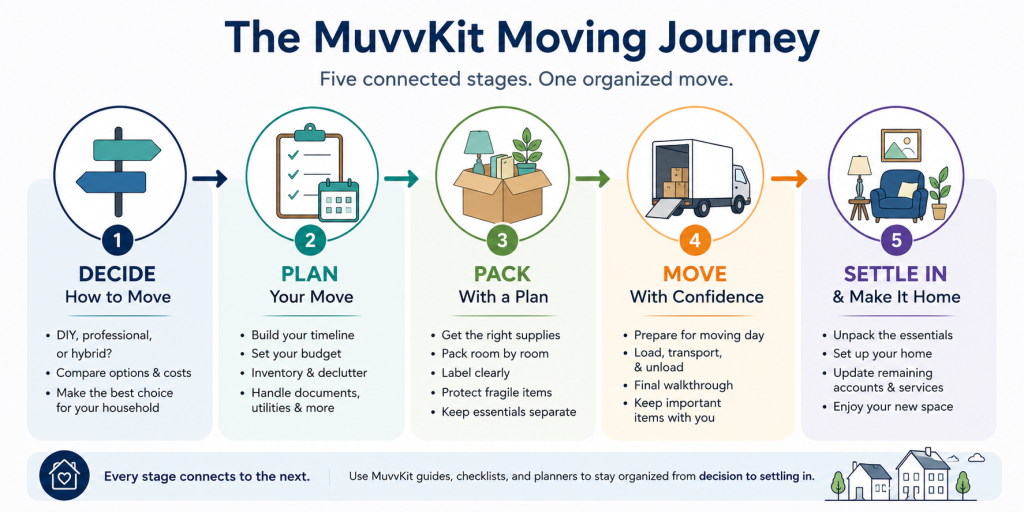
A Simple Household Moving Plan at a Glance
If the entire process still feels complicated, reduce it to this sequence:
1. Define the move.
Know your dates, locations, household needs, and constraints.
2. Choose the moving method.
DIY, professional movers, or hybrid.
3. Establish the budget.
Identify likely costs and track actual expenses.
4. Build the timeline.
Work backward from moving day.
5. Inventory and declutter.
Understand what you’re actually moving.
6. Organize records.
Keep reservations, documents, contacts, and receipts together.
7. Solve logistics.
Plan access, transportation, and requirements at both homes.
8. Pack systematically.
Start with nonessentials and label consistently.
9. Transfer household administration.
Handle utilities, mail, and account addresses.
10. Prepare for moving day.
Confirm people, transportation, essentials, and responsibilities.
11. Execute the move.
Supervise, document, and complete a final walkthrough.
12. Settle in deliberately.
Restore essential household functions first.
This sequence is more useful than trying to remember dozens of unrelated tasks at once because each stage prepares you for the next.
Common Moving-Planning Mistakes to Avoid
Starting with packing instead of planning
Packing feels productive, but major decisions about timing, transportation, and budget usually need to come first.
Keeping several unrelated task lists
Scattered notes make it difficult to see dependencies and deadlines. Keep one master plan and use smaller lists only for specific parts of the move.
Waiting too long to choose a moving method
Transportation affects the budget, schedule, packing responsibilities, and moving-day logistics.
Moving things you already know you don’t want
Decluttering after packing wastes both packing effort and transportation space.
Treating the mover’s estimate as the entire moving budget
Your household may have expenses beyond transportation. Plan the move as a whole.
Packing critical documents
Keep identification, important records, and other necessary documents accessible.
Forgetting the destination
Planning shouldn’t focus exclusively on leaving the old home. Access, utilities, unloading, and first-night needs at the new home deserve advance attention.
Treating moving day as the finish line
Delivery starts the final phase: checking belongings, restoring household functions, unpacking and completing administrative updates.
Frequently Asked Questions
When should you start planning a household move?
Start as soon as your move becomes reasonably likely and you have enough information to make useful decisions. The ideal timeline depends on distance, household size, moving method, scheduling constraints, and how much preparation is required. If you have less time, prioritize decisions that affect transportation, housing deadlines, utilities, packing, and moving-day logistics.
What is the first thing you should do when planning a move?
Write down the basic facts: expected moving date, origin, destination, household size, important deadlines, and major constraints. Then identify the decisions that remain unresolved, especially how you’ll move.
Should you declutter before packing?
Usually, yes. Deciding what isn’t moving can reduce the amount that needs to be packed, transported, unloaded, and organized at the new home.
How should moving paperwork be organized?
Use one accessible location for estimates, contracts, reservations, receipts, inventory records, utility confirmations, and important contacts. Keep documents you’ll need during transit with you rather than inside inaccessible packed boxes.
What changes when you’re moving interstate?
If you’re hiring a company to transport household goods across state lines, federal interstate household-goods regulations may apply. FMCSA provides official resources for checking movers and brokers, understanding estimates, reviewing consumer rights and learning about liability options. Intrastate moves may instead be subject to state-specific requirements.
What if you have less than eight weeks to plan?
Don’t try to compress an eight-week checklist mechanically. Identify the tasks with dependencies and deadlines first: choose your moving method, secure transportation or movers, establish a budget, start decluttering and packing, arrange utilities and address changes, and prepare the final-week and moving-day logistics.
Your Moving Plan Should Make the Next Step Obvious
A good household moving plan doesn’t eliminate every surprise.
It gives you a reliable way to decide what needs attention next.
Start with the facts of the move. Choose your moving method. Build the budget and timeline. Reduce and inventory what you’re taking. Organize the paperwork. Solve the logistics. Pack systematically. Prepare for moving day. Then carry the same organized approach into the new home.
You don’t need to manage the entire move in your head at once.
You only need a system that keeps the next important task visible.
Ready to put your plan into action?
Organize Your Household Move in One Place
The MuvvKit Complete Moving Planner Bundle brings your timeline, budget, belongings, packing plans, moving-method decisions, and other important moving details together in one structured planning system.
Explore the Complete Moving Planner →Use the free MuvvKit guides on their own or pair them with the planner when you want a structured place to organize the details.
References & Sources
MuvvKit uses authoritative sources to verify consumer-protection, regulatory, tax, and other factual information included in this guide. The following resources were consulted for this article:
- Federal Motor Carrier Safety Administration (FMCSA) — Protect Your Move
Official U.S. Department of Transportation resources for consumers planning an interstate household-goods move, including mover research, consumer protections, and moving guidance.
https://www.fmcsa.dot.gov/protect-your-move - Federal Motor Carrier Safety Administration (FMCSA) — Consumer Rights and Responsibilities
Information about consumer rights and responsibilities when using an interstate household-goods mover or broker.
https://www.fmcsa.dot.gov/protect-your-move/consumer-rights - Federal Motor Carrier Safety Administration (FMCSA) — What Is an Interstate Move?
Federal guidance explaining interstate household-goods moves and when federal interstate moving requirements may apply.
https://www.fmcsa.dot.gov/consumer-protection/protect-your-move/are-you-moving/what-interstate-move - Federal Motor Carrier Safety Administration (FMCSA) — How Can I Avoid Unexpected Moving Costs?
Consumer guidance covering written estimates and important considerations when evaluating interstate moving costs.
https://www.fmcsa.dot.gov/consumer-protection/protect-your-move/how-can-i-avoid-unexpected-moving-costs - Federal Motor Carrier Safety Administration (FMCSA) — Liability and Protection
Official information about Full Value Protection, Released Value, and liability options for interstate household-goods moves.
https://www.fmcsa.dot.gov/consumer-protection/protect-your-move/are-you-moving/liability-protection - Internal Revenue Service (IRS) — Topic No. 455, Moving Expenses for Members of the Armed Forces
Current federal tax guidance concerning eligibility and rules for deducting qualifying moving expenses. Tax rules can change, so readers should review current IRS guidance for their circumstances.
https://www.irs.gov/taxtopics/tc455
Source Note
Moving regulations, tax rules, government procedures, and consumer-protection requirements can change. When a requirement applies to your move, verify the current information directly with the appropriate government agency or other authoritative source.
Last source review: August 2026