What to Compare Before Choosing a Moving Company
Choosing a moving company involves more than comparing prices. Learn how to compare estimates, services, registration, liability protection, possible extra charges, complaint history, and written terms before making a decision.

Choosing a professional mover calls for more than lining up quoted prices. A useful comparison asks whether each company is offering the same scope of work, who will be responsible for the shipment, how the estimate was built, which charges could change, what protection applies to the belongings, and whether the paperwork supports what the company has promised.
For interstate household moves, federal consumer-protection rules provide several useful checkpoints. Moves that stay within one state can be governed by different state or local requirements, so those rules should be checked separately.
Use one comparison framework for every company
A side-by-side review works best when every candidate is measured against the same categories. Before making a selection, collect enough information to compare:
- The company’s role in the move
- Federal registration when the shipment crosses state lines
- The written estimate and the inventory behind it
- Included services and circumstances that may create additional charges
- Pickup and delivery arrangements
- Liability choices for loss or damage
- Payment, cancellation, and change terms
- Complaint information and warning signs
- The clarity and consistency of the company’s documents
This approach helps separate a genuinely different offer from an estimate that only looks less expensive because it covers less.
1. Identify who is arranging the move and who is transporting it
Begin with the company’s role. Some businesses transport household goods themselves, while others arrange for another carrier to perform the move.
For an interstate shipment, FMCSA treats these as different business roles. A household-goods mover is responsible for transporting the shipment. A broker connects the customer with a carrier and is not authorized to transport the household goods as the mover.
That distinction should be clear before comparing prices. Record the legal or advertised business name, physical business location, available federal registration identifiers, and whether the company represents itself as the carrier or as a broker.
If a broker is involved, find out which carrier is expected to perform the transportation and what information will be provided before the move. The purpose of this step is simple: know which business is selling or arranging the service and which business will have physical responsibility for the shipment.
If full-service moving feels unnecessary but handling the entire move alone is unrealistic, consider combining DIY moving with professional help for selected tasks.
2. Check the registration that applies to an interstate move
For moves between states, use FMCSA’s consumer resources to check the business rather than treating a registration number printed on a website as sufficient verification.
FMCSA states that interstate household-goods movers and brokers must be registered with the agency. Its search resources can also provide complaint-history information.
Registration answers an important eligibility question, but it should not be treated as a quality rating. Use it as one part of the comparison, alongside the written estimate, business role, documents, and other information you collect.
If the entire move remains within one state, identify the state or local authority that regulates household-goods movers in that jurisdiction and check the requirements that apply there.
3. Put written estimates on equal footing
Once the companies have been identified, compare their written estimates.
For interstate moves, FMCSA requires a mover’s estimate to be in writing and to describe the shipment and services being priced. A general rate quotation does not provide the same basis for comparison.
For each estimate, note:
- Whether the estimate is binding or non-binding
- Which belongings are represented in the shipment
- Which transportation and service charges appear
- Whether packing or unpacking is included
- Whether storage is included or may be needed
- Which access conditions have been considered
- Which payment methods will be accepted
- What changes could alter the amount owed
The most useful price comparison begins only after you confirm that the estimates describe substantially the same move.

4. Understand how each type of estimate can change
The label on an estimate affects what the quoted amount means.
Under federal interstate-moving rules, a binding estimate establishes charges for the shipment and services described in that written agreement. If the customer adds goods or requests work that was not part of the original scope, the mover may need to address those changes before loading.
A non-binding estimate works differently. It is an approximation, with final lawful charges tied to factors such as the shipment’s actual weight, services performed, and the mover’s applicable tariff provisions. Federal rules also limit how much of a non-binding estimated amount may generally be demanded at delivery, although properly chargeable additional services or certain access-related operations can affect what is due.
When reviewing competing estimates, therefore, compare both the number and the pricing structure behind it. Two totals are not directly equivalent when one is binding, and the other is non-binding.
Once you have compared the offers, use this step-by-step guide to hire professional movers for a household move and verify the details before confirming your booking.
5. Look at the information used to build the estimate
An estimate is only as useful as the description of the move behind it.
Check whether the company obtained a meaningful view of the household goods and the conditions at the origin and destination. FMCSA’s interstate rules address physical surveys and circumstances in which a shipper may waive applicable survey requirements in writing.
For comparison purposes, focus on whether each company has accounted for the same practical details:
- The quantity and type of belongings
- Large, fragile, or unusually difficult items
- Packing work requested from the mover
- Stairs and elevators
- Distance between the residence and where the truck can park
- Building or parking restrictions
- Additional pickup or delivery stops
- Potential storage needs
If one estimate was prepared from detailed information and another rests on broad assumptions, resolve those differences before deciding which price is more favorable.
6. Separate included services from possible additional work
A total can be misleading when companies package services differently.
Review what each mover has actually included. Furniture handling, packing materials, disassembly, reassembly, appliance preparation, specialty handling, storage, or access-related work may be treated differently from one estimate to another.
Access conditions deserve particular attention. Federal moving terminology recognizes services associated with circumstances such as stairs, elevators, long carries, or situations where a larger vehicle cannot practically reach the residence.
Instead of assuming that a missing charge means the service is free, ask what the estimate assumes. If an issue could reasonably affect the final charges, request an explanation in writing.
Keep Your Moving Company Comparisons Organized
The MuvvKit Mover Comparison Workbook gives you one place to record estimates, services, company details, questions, and important terms while you evaluate professional movers.
Explore the Mover Comparison WorkbookWhen comparing companies, ask whether they offer labor-only, loading, transportation, specialty-item, or partial-packing services. These options may support a hybrid DIY and professional move without requiring a complete full-service package.
7. Compare pickup, delivery, and communication arrangements
A moving-company comparison should also account for how the shipment will be handled between the two homes.
Review the written pickup and delivery information and ask how changes will be communicated. Useful points to compare include:
- The pickup date or agreed window
- The delivery date or agreed window
- The contact method during transit
- Procedures for schedule changes
- Whether storage in transit could become part of the move
- Who should be contacted about a delay or delivery issue
For interstate moves, the order for service and bill of lading contain important shipment terms. The written documents should agree with the timing and service expectations discussed with the company.
8. Read the liability choices carefully
Do not treat broad phrases such as “covered” or “insured” as a substitute for the actual liability terms.
Interstate movers must provide liability choices for household goods. FMCSA describes Full Value Protection and Released Value as distinct levels of responsibility. Released Value provides limited protection calculated by weight, while Full Value Protection carries different repair, replacement, or settlement obligations subject to its terms.
When comparing companies, identify:
- The liability option shown in the documents
- Any charge associated with the selected protection
- Applicable deductible or settlement provisions
- Requirements for declaring especially valuable articles
- The process described for loss or damage claims
If separate insurance is offered through another insurer, keep that product conceptually separate from the mover’s federally required liability options.
9. Review complaint information without turning it into a score
FMCSA allows consumers to review complaint-history information for interstate movers and brokers. That information can be useful, but it needs context.
A complaint record by itself does not explain the company’s volume of moves, the circumstances behind each report, or the outcome of every dispute. Use complaint information to identify issues worth investigating rather than reducing the decision to a single number.
Then compare what you find with the company’s current behavior and paperwork. Inconsistencies between names, registration information, estimates, promises, and written terms deserve clarification before you sign.
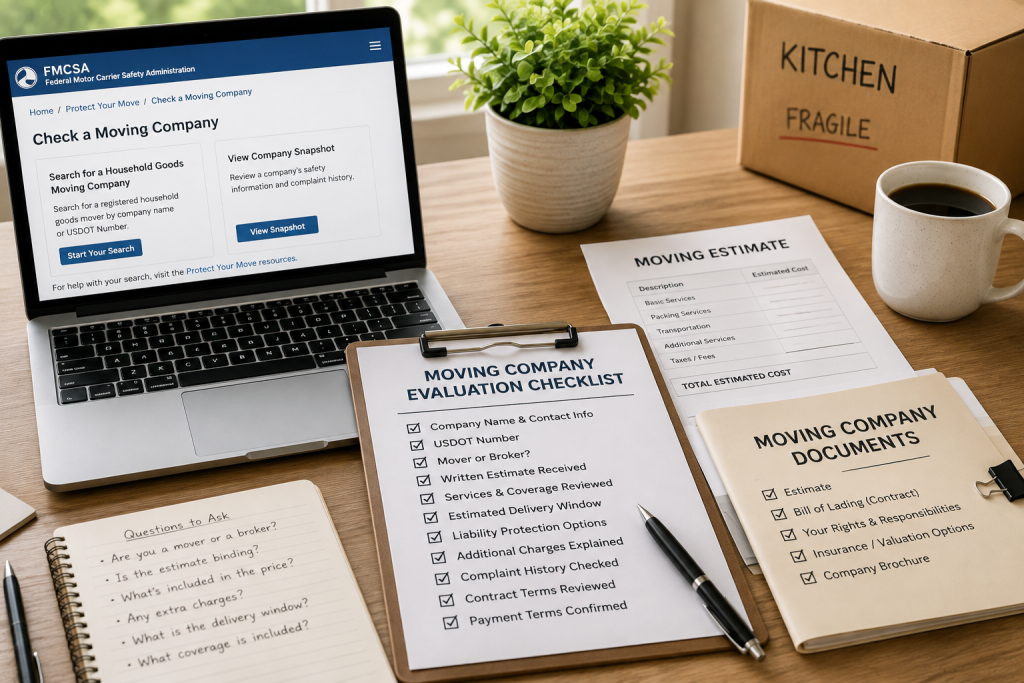
10. Watch for conduct that makes the comparison unreliable
Some warning signs undermine the value of an estimate or make it harder to know what you are agreeing to.
FMCSA identifies concerns such as estimates prepared without an appropriate inspection, failure to provide a written estimate, demands for a large deposit, requests to sign blank documents, and missing required interstate consumer information.
Other comparison problems may be less dramatic but still important. Examples include unanswered questions about who will transport the shipment, documents that use inconsistent business names, unexplained changes to the scope, or verbal assurances that do not appear in writing.
The issue is not whether every administrative mistake proves wrongdoing. It is whether you have enough consistent information to understand and compare the transaction before committing to it.
11. Read payment and change terms before judging the total
Price also includes the rules governing when and how money becomes due.
For each company, document the accepted payment methods, deposit requirements, amount expected at delivery, and policies governing cancellation or rescheduling. For interstate shipments, FMCSA requires payment information to be addressed in the mover’s paperwork.
Also review how changes are handled. A change in the belongings being moved, requested services, or access conditions can affect the agreement. Knowing the process in advance makes it easier to distinguish an authorized adjustment from an unexplained price increase.
12. Make the final comparison from one completed worksheet
After gathering the documents, bring the information into one side-by-side record.
Use the same fields for every candidate:
- Business role identified
- Applicable registration checked
- Written estimate received
- Estimate type recorded
- Shipment description reviewed
- Included services listed
- Potential additional services identified
- Pickup and delivery terms reviewed
- Liability choice understood
- Payment and cancellation terms recorded
- Complaint information checked
- Outstanding questions answered in writing
This prevents a common comparison problem: choosing one company because of price, another because of reviews, and a third because of services without ever measuring them against the same criteria.
A practical standard before you choose
Before selecting a moving company, you should be able to describe the proposed transaction without relying on sales language.
You should know which business will transport the shipment, what the estimate covers, what circumstances could change the charges, which services are included, what pickup and delivery terms apply, what liability option you selected, and when payment is due.
If you cannot make those points clear for every company on your shortlist, the comparison is not finished. Gather the missing information first, then evaluate the offers on the same basis.
Frequently Asked Questions
What matters most when comparing moving companies?
Start with whether you are comparing equivalent services. Identify the business role, verify applicable interstate registration, review the written estimate and shipment description, and check which services and possible additional charges are represented. After those elements are aligned, the quoted totals are easier to evaluate meaningfully.
Should I pick the moving company with the lowest estimate?
A lower figure does not necessarily represent the same service. Differences in inventory, estimate type, packing, access assumptions, storage, or other services can produce different totals. Review the scope and pricing terms before using price as a deciding factor.
Do I need several moving estimates?
Federal rules do not require a consumer to collect a particular number of competing estimates. Having more than one written proposal can help reveal differences in assumptions, services, and pricing, but each estimate still needs to be reviewed carefully. The objective is a useful comparison, not reaching an arbitrary number.
How can I verify an interstate moving company?
Use FMCSA’s consumer search resources to check whether the business is registered for its stated role and to review available complaint information. Match the search results against the company name and registration details in your documents. A move that remains entirely within one state may require verification through a different state or local regulator.
Why does it matter whether I am dealing with a mover or a broker?
The roles are different. An interstate mover transports the household goods, while a broker arranges transportation with a carrier. Identifying the role helps you understand which business is arranging the transaction and which carrier is expected to take responsibility for transporting the shipment.
What is the main difference between a binding and non-binding estimate?
A binding interstate estimate sets the charges for the shipment and services described in the agreement, subject to applicable changes in scope or services. A non-binding estimate is an approximation; final lawful charges are determined under the applicable pricing rules based on the shipment and services actually provided. The two types should therefore not be compared as though the quoted numbers carry identical meaning.
Continue Planning Your Professional Move
Comparing companies is one part of the hiring process. Continue with MuvvKit’s professional movers guide to work through estimates, verification, moving documents, final confirmations, and other important steps before moving day.
Read the Professional Movers GuideReferences & Sources
1. Federal Motor Carrier Safety Administration — Movers vs. Brokers
Explains the different roles of interstate household-goods movers and brokers, including federal registration and broker requirements.
FMCSA Movers vs. Brokers
2. Protect Your Move — Estimating Charges (Subpart D)
Details federal requirements for interstate written estimates, including binding and non-binding estimates and circumstances that can affect estimated charges.
FMCSA Estimating Charges — Subpart D
3. Federal Motor Carrier Safety Administration — Protect Your Move
Provides broader consumer guidance for interstate household-goods moves, including checking a mover, understanding responsibilities, preparing for a move, and recognizing potential problems.
FMCSA Protect Your Move
4. Your Rights and Responsibilities When You Move
FMCSA’s consumer handbook covering estimates, moving documents, liability protection, pickup and delivery responsibilities, claims, and other federal protections for interstate moves.
FMCSA Your Rights and Responsibilities When You Move
5. Federal Motor Carrier Safety Administration — File a Moving Fraud Complaint
Explains how consumers can report problems involving interstate movers and brokers and identifies types of conduct that may warrant a complaint.
FMCSA File a Moving Fraud Complaint
Editorial Note: MuvvKit uses authoritative sources to verify factual and regulatory information while developing its moving guides. Federal moving requirements cited in this article primarily apply to interstate household-goods moves in the United States. Requirements for moves conducted entirely within one state may differ, so readers should also consult the appropriate state or local regulator. External sources are provided for reference and were reviewed for relevance at the time this article was prepared.