Moving Documents to Keep Together Before, During, and After a Move
Keep contracts, identification, inventories, confirmations, receipts, and essential records organized and accessible throughout a household move.

A move creates paperwork at the same time that rooms, routines, and addresses are changing. Keeping the right moving documents together makes it easier to confirm arrangements, prove what was agreed to, complete time-sensitive tasks, and find essential records without opening packed boxes.
Keeping important records together is one part of maintaining an organized move. Our household move planning checklist places document management alongside scheduling, budgeting, inventory, packing, transportation, and moving-day preparation.
The goal is not to carry every household file. Instead, identify the records that may be needed during the transition, protect irreplaceable originals, and create a clear place for new documents as they arrive. This guide explains what to gather before moving day, what to keep accessible in transit, and what to retain after delivery.
For the broader sequence surrounding these tasks, use MuvvKit’s step-by-step household moving guide alongside this document review.
Why Moving Documents Need Their Own Plan
Moving paperwork does not belong in one undifferentiated stack. Some documents are needed at pickup or delivery, some contain sensitive personal information, and others are useful only if a dispute, claim, refund, enrollment question, or address problem develops later.
A document can also serve more than one purpose. A mover’s inventory may help confirm delivery, while photographs and receipts may support a later claim. A lease may be needed for key collection, utility setup, parking authorization, or proof of residence. Keeping related records together preserves that context.
MuvvKit’s practical framework uses three layers:
- A working move file for documents that may be needed before, during, or immediately after the move.
- A protected-originals file for identity, legal, financial, medical, and other hard-to-replace records that should remain under the household’s direct control.
- A secure digital index or backup that helps authorized household members locate copies and track confirmations without exposing sensitive records unnecessarily.
This three-layer structure is an original MuvvKit editorial method, not an official filing requirement. Adjust it for the household, the moving method, the destination, and any legal or contractual instructions that apply.
Start With a Document Inventory
Before collecting paper, make a short inventory of the records connected to the move. Record the document name, responsible person, current location, whether an original is required, and the next action. This reduces duplicate printing and exposes missing signatures, expired identification, incomplete forms, and records held by another family member.
Use the document’s function to decide where it belongs:
- Needed to enter, travel, pay, collect keys, or confirm service: place it in the working move file.
- Difficult or time-consuming to replace: keep the original in the protected file and use a copy when accepted.
- Useful for reference but not required in person: store it securely and add it to the digital index.
- No longer valid or useful: follow the issuer’s retention guidance and use secure destruction when the record contains personal information.
Do not assume that a photograph or scan can replace an original. Agencies, schools, landlords, carriers, lenders, insurers, employers, and travel providers may require a specific format, certification, seal, signature, or current version.
Your household inventory should be created before packing makes individual belongings harder to document. Follow this process to make a household inventory before a move and keep a copy with your other essential moving records.
Moving Documents to Gather Before the Move
Moving-service estimates and agreements
For a professional move, keep the estimate, order for service, bill of lading, tariff or rate information provided to you, valuation or liability selection, inventory sheets, add-on service approvals, payment terms, and the mover’s contact information together. Review names, addresses, dates, service level, pickup and delivery information, and any conditions that could affect charges.
For interstate moves, the Federal Motor Carrier Safety Administration describes the bill of lading as the contract between the customer and mover and a receipt for the belongings. Read the document before signing and retain a copy. Requirements for local and intrastate moves can differ, so verify them with the carrier and the relevant state authority.
For a rental truck, container, or hybrid move, retain the reservation, equipment description, pickup and return instructions, coverage selections, fuel or charging terms, mileage terms, access requirements, and receipts for separately booked labor.

Housing and property-access records
Keep the signed lease, purchase or sale closing documents needed for the transition, possession or key instructions, inspection reports, security-deposit records, building rules, elevator reservations, parking approvals, proof of insurance when requested, and contact details for the landlord, property manager, closing professional, or association.
Separate documents needed on a specific day from the larger housing file. For example, a key-release email and loading reservation belong in the working move file, while the full closing packet can remain protected unless a particular page is needed.
Identity, authority, and travel documents
Keep government-issued identification, passports when relevant, immigration documents, birth and marriage records, custody documents, powers of attorney, and other proof of legal authority under direct control. Carry only what the move or related travel requires. Avoid leaving these records in a parked vehicle, an unlocked bag, or a box handled by movers.
If one person will act for another, confirm what the organization requires. A general copy of a document may not be sufficient. For example, USPS identifies additional documentation for certain in-person change-of-address requests made by an authorized agent.
Medical, school, and pet records
Gather current medication information, insurance details, provider contacts, essential care instructions, immunization records when needed, and any records required to continue treatment. Federal health-information guidance explains that individuals generally have rights to inspect and obtain copies of health and billing records held by covered health plans and providers, but request processes and available formats vary.
For children or students, confirm enrollment and transfer procedures with both schools. Keep identification, proof-of-residence documents, enrollment confirmations, immunization records when required, individualized education or accommodation documents, and school contact information accessible. FERPA governs privacy and access for covered education records, but state and district procedures still matter.
For pets, keep vaccination records, prescriptions, microchip information, veterinarian contacts, and any health certificate or destination-specific paperwork. USDA APHIS directs pet owners to verify state-to-state requirements with the destination state and other responsible authorities.
Household inventory and proof of condition
Keep the household inventory, high-value item list, serial numbers, photographs, videos, appraisals when relevant, and purchase receipts that may help identify ownership or condition. Store copies somewhere other than the shipment. An inventory is most useful when it connects an item description to a room, box, photograph, receipt, or carrier inventory number.
Address, account, and service confirmations
Save confirmation numbers and effective dates for mail forwarding, utilities, insurance, financial accounts, subscriptions, schools, employers, benefits, and other address changes. USPS notes that a postal change-of-address request does not update government agencies or private companies automatically. Keep a separate checklist of organizations that must receive the new address directly.
Retain the USPS confirmation code because it may be needed to modify or cancel the request. For tax administration, use the IRS’s current address-change options and keep a copy or confirmation of what was submitted.
Need one place for address updates?
Track Organizations, Dates, and Confirmations
The MuvvKit Address Change Organizer provides a structured place to record who needs the new address, when each update was submitted, and which confirmations still need attention.
Explore the Address Change Organizer →Small details such as phone numbers, confirmation codes, measurements, questions, and follow-up tasks can be easy to lose. Keep them together with the printable Moving Notes pages instead of scattering them across separate scraps of paper.
What to Keep Accessible During the Move
The working move file should travel with an authorized household member, not inside the moving truck or container. A weather-resistant folder or compact document case can protect paper from spills and repeated handling. If flying, follow carrier rules and keep essential records in personal or carry-on baggage.
Include only the records likely to be needed in transit or at arrival:
- Pickup and delivery contacts, addresses, reservation numbers, and access instructions.
- The current estimate, order for service, bill of lading, mover inventory, rental or container agreement, and approved service changes.
- Identification, payment method, travel confirmations, and documents required to collect keys or enter the property.
- Current medication information, prescriptions, essential medical instructions, insurance cards, and emergency contacts.
- Pet travel or health records required along the route or at the destination.
- A copy of the household inventory and a way to record delivery exceptions, missing items, or visible damage.
- Receipts created during the move, especially for transportation, lodging, storage, supplies, tolls, fuel, labor, and emergency purchases.
Create a simple rule for new paperwork: review it, photograph or scan it if appropriate, record any action or deadline, and place it in the working file. Loose receipts and unsigned service changes are easy to lose during a long day.
A Stage-by-Stage Document Guide
| Stage | Keep together | Why it may matter | Location |
| Before | Quotes, contracts, housing records, access approvals, inventory, address-change confirmations | Verifies arrangements and reveals missing actions before packing becomes disruptive | Working file or protected originals |
| Moving day | Bill of lading, inventory sheets, IDs, key instructions, contacts, payment records | Supports pickup, access, delivery, payment, and exception recording | Carried by an authorized household member |
| First weeks | Delivery paperwork, inspection notes, damage evidence, utility and deposit records | Helps complete claims, refunds, address updates, and account closures | Active post-move file |
| Long term | Final contracts, tax-relevant records, warranties, settled claim documents | Preserves records according to issuer, legal, tax, insurance, or household needs | Secure household archive |
Documents to Review Immediately After Delivery
Do not archive the move file as soon as the last box arrives. First, reconcile the documents created before and during the move.
- Compare the mover’s or carrier’s inventory with what was delivered and retain any notation of loss or damage.
- Photograph visible damage and packaging before discarding material that may be relevant to a claim.
- Keep final invoices, payment receipts, storage releases, equipment-return confirmations, and approved charge changes.
- Retain move-out and move-in inspection records, key-return receipts, deposit correspondence, and final utility statements.
- Confirm that mail forwarding and direct address updates are operating as expected.
- Track outstanding reimbursements, refunds, claims, repairs, or documentation requests until each item is resolved.
Contractual notice and claim procedures can have specific deadlines and evidence requirements. Review the documents you received instead of relying on a general online timeline. For an interstate household-goods move, use FMCSA’s consumer guidance and the mover’s written materials to understand the applicable process.
Protect Sensitive and Irreplaceable Records
A move increases the number of people, vehicles, temporary locations, and open containers around the household. Use that transition to reduce unnecessary exposure rather than creating large packets of sensitive copies.
- Carry irreplaceable originals personally when practical and permitted.
- Use a locked or continuously supervised container for sensitive paper.
- Limit full account numbers and identity documents in the general working file.
- Protect digital files with strong account security, device locks, and access limited to people who need it.
- Do not send sensitive records through ordinary email unless the sender and recipient have an appropriate secure method.
- Use secure destruction for unneeded duplicates rather than placing them intact in recycling or trash.
Ready.gov’s financial-preparedness guidance identifies records such as identification, insurance information, household contacts, and financial documents as part of preparedness planning. That guidance supports keeping critical information accessible and protected, although a moving file is not a substitute for a broader emergency plan.
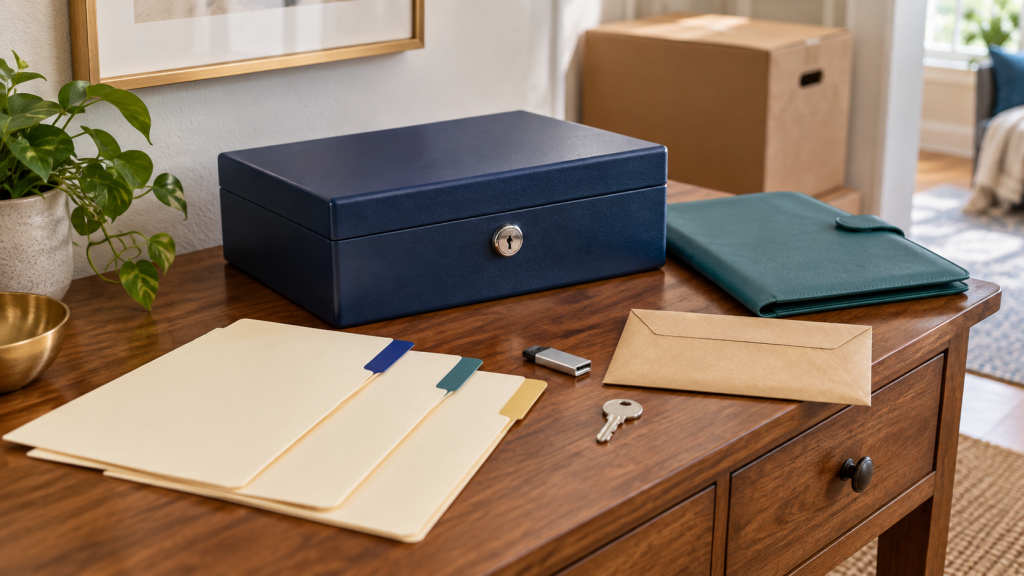
How to Build the Moving Document System
Use a short sequence that can be maintained throughout the move:
- List the document categories that apply to the household.
- Verify names, addresses, dates, signatures, expiration dates, and missing pages.
- Separate working copies from protected originals.
- Create secure digital copies when useful and legally acceptable.
- Name files consistently with a category, subject, and date rather than vague labels such as scan1.
- Assign one primary custodian and one backup person who knows where the records are.
- Review the file before pickup, before departure, at delivery, and after outstanding issues are resolved.
The review points are a MuvvKit planning framework, not official deadlines. Contracts, agencies, schools, health providers, and local authorities may set different timing or document requirements.
Frequently Asked Questions
Should original documents go on the moving truck?
Generally, keep irreplaceable identity, legal, financial, medical, and travel documents under the direct control of an authorized household member. Whether a particular original must travel depends on how soon it may be needed and what the issuing organization requires.
Are digital copies enough for a move?
Digital copies are useful for reference and backup, but they may not replace certified or original documents. Confirm the required format with the organization receiving the record. Protect scans because they can contain the same sensitive information as paper originals.
Which mover documents should I keep on moving day?
Keep the current estimate, order for service, bill of lading, carrier inventory, valuation or liability selection, approved service changes, payment terms, receipts, and pickup and delivery contacts accessible. The exact documents differ by moving method and jurisdiction.
How long should moving documents be retained?
There is no single retention period for every moving document. Keep active contracts and claim evidence until obligations and disputes are resolved. Then follow applicable tax, legal, insurance, warranty, lease, employer, and issuer guidance. Seek qualified advice when a record may affect a legal or tax matter.
What should be in a moving document folder?
A practical folder includes current moving agreements, access and key instructions, identification needed for the trip, essential medical and pet records, address-change confirmations, an inventory copy, receipts, and contact information. Sensitive originals can remain in a separate protected case.
Keep the Paperwork as Organized as the Move
Moving documents are easier to manage when each record has a purpose, a responsible person, and a secure location. Gathering them before packing accelerates the process of carrying the documents needed for access and delivery, and keeping the file active until claims, refunds, address updates, and account closures are complete.
The best system is not the largest one. It is the one that lets the household produce the right document when it is needed while keeping sensitive and irreplaceable records protected.
Organizing more than paperwork?
Keep the Documents and the Wider Move Connected
The MuvvKit Complete Moving Planner Bundle brings timelines, budgets, household inventories, packing plans, mover comparisons, and moving-day details into one structured system.
Explore the Complete Moving Planner →References and Resources
Editorial Note. These sources were selected because they are official U.S. government resources addressing interstate moving documents, mail forwarding, tax-address changes, financial preparedness, health-record access, student-record privacy, and pet travel. This article provides general informational guidance. The three-layer document system, stage-based file structure, and suggested review points are original MuvvKit editorial frameworks, not government, legal, tax, carrier, school, medical, or insurance requirements. Procedures, forms, fees, deadlines, acceptance standards, and service details can change. Verify current requirements with the appropriate agency, provider, carrier, contract, lease, school, veterinarian, insurer, employer, manufacturer, or local authority.
- Federal Motor Carrier Safety Administration – Protect Your Move: Subpart D, Requirements for Estimates, Orders for Service, and Bills of Lading
- United States Postal Service – Standard Forward Mail and Change of Address
- Internal Revenue Service – Address Changes
- Ready.gov – Financial Preparedness
- U.S. Department of Health and Human Services – Your Medical Records
- U.S. Department of Education – Family Educational Rights and Privacy Act
- USDA APHIS – State-to-State Pet Travel