How to Pack for a Move: A Room-by-Room Household Packing Guide
Learn how to pack for a move with a practical room-by-room system. Organize boxes, protect fragile belongings, separate essentials, and make unpacking easier before moving day arrives.
Packing an entire home can feel manageable when you focus on one closet or one box at a time. It becomes much harder when you’re looking at a kitchen full of dishes, bedrooms full of clothing, a garage full of tools, and dozens of things your household still needs before moving day.
The solution isn’t simply to start putting things into boxes.
A smoother move comes from packing in the right order, using a consistent system, and treating each room differently based on what it contains and when you’ll need it again.
If you are unsure how early to begin, use this guide to determine when you should start packing for a move based on your household size, available time, and moving-day deadline.
This room-by-room guide walks you through how to pack for a move without turning your home into an unorganized maze of boxes.
- Decide what to pack first.
- Reduce what you’re moving before you box it.
- Create a simple labeling and inventory system.
- Pack kitchens, bedrooms, bathrooms, living areas, offices, garages, and other household spaces.
- Separate essentials you shouldn’t load onto the moving truck.
- Prepare fragile and high-value belongings more carefully.
- Make unpacking easier before you even leave your current home.
Good packing isn’t about filling boxes quickly. It’s about making sure the right belongings arrive safely and can be found when you need them.
Before You Pack: Build the System First
One of the easiest packing mistakes is starting with boxes before deciding how the move will be organized. You pack a few things from the kitchen. Then you find something from the office that fits in the same box. Later, you add a bathroom item because there’s still space. The box may be full, but you’ve created a problem for your future self.
Before items disappear into boxes, photograph valuable belongings and record their condition. This guide explains how to make a household inventory before a move so you have an organized record for tracking, unpacking, and possible damage claims.
Before packing your first box, establish a simple system that answers four questions: What is inside? What room does it belong in? Does it require special handling? How important is it to unpack quickly?
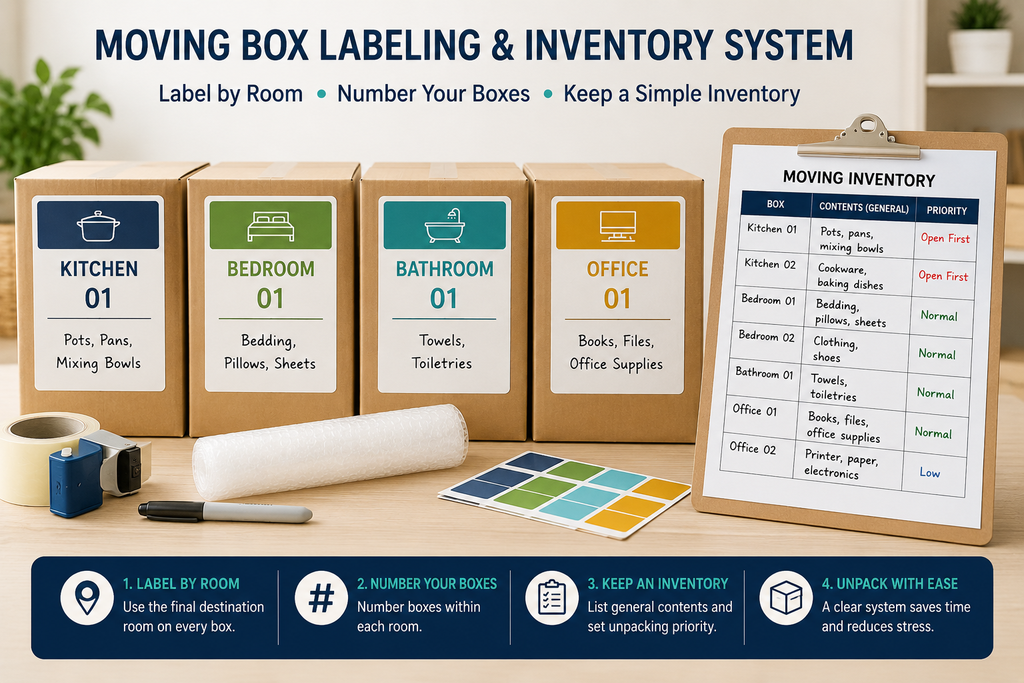
A basic label might read: KITCHEN – Box 07; Pots, mixing bowls, baking sheets; OPEN FIRST. You don’t need a complicated inventory database. You need a system you can use consistently.
1. Declutter Before You Pack
Packing things you don’t actually want is wasted effort. Every item you remove before the move means one less item to wrap, box, carry, transport, unload, and find space for in the new home.
- Keep
- Donate
- Sell
- Recycle
- Dispose
- Unsure
Try not to let the “unsure” category become another name for “pack everything.” Ask whether you use the item, whether you would buy it again today, whether it will have a useful place in the new home, and whether transporting it is worth the space, weight, or effort.
Large furniture deserves particular attention. A bulky cabinet that doesn’t fit the layout of the new home may cost more – in money or effort – to move than it’s worth. Decluttering early also gives you time to donate, sell, recycle, or properly dispose of belongings instead of making rushed decisions during the final days.
2. Gather Your Packing Supplies
Once you’ve reduced what you’re taking, estimate the materials you’ll need.
- Moving boxes in several sizes
- Packing tape
- Packing paper
- Cushioning material
- Markers
- Labels
- Resealable bags
- Stretch wrap
- Furniture pads or moving blankets
- Mattress bags
- Specialty boxes where appropriate
- Scissors or a tape dispenser
Avoid automatically packing heavy items into your largest boxes. Large boxes are generally better for lighter, bulky items such as bedding and pillows. Books, canned goods, and other dense belongings are usually easier to handle in smaller boxes.
Your goal isn’t to maximize how much fits into every container. Your goal is to create boxes that can be closed securely, stacked appropriately, and handled safely.
Before opening the first cartons, use this moving packing supplies checklist to separate essential materials from products needed only for specific belongings.
3. Create a Room-by-Room Labeling System
Choose your labeling method before the house fills with boxes. Assign each destination room a clear name, such as Kitchen, Primary Bedroom, Bedroom 2, Living Room, Office, Bathroom 1, and Garage. Then number the boxes within each room: Kitchen 01, Kitchen 02, Kitchen 03.
Use a consistent system for labeling moving boxes with destinations, box numbers, priorities, and contents cues as each carton is sealed.
Maintain a basic inventory with the box number, general contents, and unpacking priority. You don’t need to list every spoon or T-shirt. The inventory should contain enough information to help you locate something without opening six boxes.
For an interstate move using a professional mover, documentation becomes particularly important. The Federal Motor Carrier Safety Administration (FMCSA) explains that interstate movers prepare a shipment inventory before or at loading, and consumers should review it for accuracy.
The order in which rooms are packed can make the rest of the process easier. Review the best room-by-room order for packing a home before beginning so essential spaces remain usable for as long as possible.
4. Decide What to Pack First
Packing your home in everyday-use order usually doesn’t work. Instead, pack according to how soon you’ll need something again.
If you are unsure where to begin, use this guide to decide what to pack first when moving, based on how long each category can remain unavailable.
Pack early
- Seasonal decorations
- Books
- Collectibles
- Framed decor
- Rarely used kitchen equipment
- Off-season clothing
- Spare linens
- Guest-room belongings
- Archived paperwork
- Hobby supplies you won’t use before moving
Pack later
- Everyday cookware
- Work clothing
- Toiletries
- Medications
- Chargers
- Cleaning supplies
- Pet supplies
- Children’s daily necessities
- Basic tools
- Frequently used electronics
This gradually converts your home from normal living mode into moving mode without making daily life unnecessarily difficult.
5. How to Pack the Kitchen
The kitchen is often one of the most time-consuming rooms to pack because it combines fragile items, heavy items, appliances, food, and things you continue using until shortly before moving. Start earlier than you think you’ll need to.
Begin with rarely used kitchen items
- Specialty appliances
- Serving platters
- Extra glassware
- Baking equipment
- Seasonal dishes
- Cookbooks
- Duplicate utensils
- Entertaining supplies
Keep only the cookware and dishes you expect to use during the remaining days.
Pack dishes carefully
Use appropriate cushioning between fragile pieces and prevent items from shifting inside the box. Don’t assume that writing FRAGILE on the outside will compensate for inadequate packing inside. Fill empty spaces appropriately so contents can’t move freely when the box is handled.
Separate heavy kitchen items
Pots, pans, cast-iron cookware, canned goods, and small appliances can make boxes extremely heavy. Use manageable boxes and distribute weight instead of concentrating everything into one large container.
Reduce your pantry
In the weeks before moving, begin using food already in your pantry and freezer. This reduces both waste and the amount that must be transported. Check with your mover before packing food if you’re using professional moving services, particularly for perishables or items that may be restricted.
6. How to Pack Bedrooms
Bedrooms are usually easier to organize when you separate belongings by person and destination room. Don’t label every bedroom box simply BEDROOM. If the new home has multiple bedrooms, use specific destination labels such as Primary Bedroom, Child Bedroom 1, and Guest Bedroom.
Clothing
Start with out-of-season clothing, formal wear, extra shoes, accessories you rarely use, and clothing you won’t need before the move. Leave yourself a small moving-week wardrobe. Wardrobe boxes can be useful for hanging garments, while folded clothing can be transferred into suitable boxes or containers.
Bedding
Keep one usable set of bedding available until your final night. Pack spare sheets, blankets, comforters, and pillows earlier. Prepare bedding for the first night at the new home separately so you don’t have to search through several linen boxes when you’re tired.
Jewelry and personal valuables
Don’t bury jewelry, irreplaceable personal items, important documents, or similar valuables somewhere inside ordinary household boxes. Keep critical valuables under your control during the move whenever practical.
7. How to Pack Bathrooms
Bathrooms look small, but they’re full of items that can leak. Start by discarding expired or unwanted products and reducing duplicates. Separate daily-use toiletries from extra supplies, and secure liquids so a leak can’t damage other belongings.
Keep enough toilet paper, towels, soap, and basic toiletries accessible for your final day in the old home and your first day in the new one.
8. How to Pack the Living Room
Living rooms often contain a mix of electronics, decor, books, lamps, artwork, and furniture. Pack decorative belongings first. Photos, artwork, books, decorative objects, and rarely used entertainment items can usually disappear weeks before moving without disrupting your household.
Electronics
Before disconnecting complicated setups, take photos showing how cables are connected. Label cords where necessary and keep related accessories together instead of creating one giant box of unidentified cables. If you still have suitable original packaging for sensitive electronics, it may provide a good fit. Otherwise, use appropriate boxes and adequate cushioning. Back up important digital data before the move as an additional precaution.
9. How to Pack a Home Office
A home office needs a different approach because it may contain both ordinary belongings and sensitive information. Start with books, archived materials, and office supplies you won’t need.
- Laptop
- Chargers
- Current work files
- Authentication devices
- Essential contact information
- Anything required to continue working
Don’t pack critical financial, identity, legal, or moving documents into an ordinary box that may become inaccessible during transit. Create a separate document folder or portable file that stays with you.
10. How to Pack the Garage, Basement, and Utility Areas
These spaces are often underestimated. They can contain tools, chemicals, outdoor equipment, heavy objects, and belongings that haven’t been touched in years. Declutter aggressively before packing.
Pay particular attention to materials that shouldn’t simply be boxed with normal household goods. The U.S. Environmental Protection Agency identifies products such as paints, cleaners, oils, batteries, pesticides, and certain other products as potential household hazardous waste and recommends following product labels and local disposal guidance.
If professional movers are transporting your belongings, ask for their prohibited-items list. Never assume that because something is normally stored in your garage, it can safely or legally be loaded into a moving truck.
11. Pack Fragile Items as a Separate Project
Fragile belongings shouldn’t be treated like ordinary box contents. Identify glassware, ceramics, mirrors, artwork, lamps, electronics, collectibles, and delicate decor before packing begins.
Use appropriately sized containers and adequate cushioning. The objective is to prevent the item from contacting hard surfaces and to reduce movement inside the container. Avoid overloading fragile-item boxes.
The label tells someone to handle the box carefully. The packing inside the box is what actually protects its contents.
12. Identify High-Value and Irreplaceable Belongings
Not everything in your home should be treated according to replacement cost alone. Family photographs, heirlooms, important records, jewelry, collectibles, artwork, and sentimental keepsakes may be difficult or impossible to replace.
Decide deliberately how these belongings will travel. If you’re hiring an interstate mover, review the mover’s requirements for high-value or extraordinary-value items and understand the liability or valuation options that apply before packing them.
13. Don’t Pack Everything Onto the Moving Truck
One of the most important packing decisions is deciding what doesn’t go into the main shipment. Prepare a separate group of belongings that stays with you – your moving-day and first-night kit.
- Identification
- Moving paperwork
- Keys
- Wallets
- Medications
- Phones and chargers
- Laptops
- Important documents
- Basic toiletries
- A change of clothing
- Children’s necessities
- Pet necessities
- Snacks and water
- Basic cleaning supplies
- Toilet paper
- Essential tools
- Bedding needed for the first night
What would create a serious problem if we couldn’t find it for 24-48 hours? Keep those things accessible.
14. Create an Open First System
Your essentials bag travels with you. Your Open First boxes are different. These are household boxes you want to identify immediately after unloading.
- Kitchen – OPEN FIRST: basic cookware, mugs, dish soap, paper towels
- Bathroom – OPEN FIRST: towels, toilet paper, soap, shower necessities
- Bedroom – OPEN FIRST: sheets, pillows, blankets, sleepwear
- Cleaning – OPEN FIRST: trash bags, paper towels, basic cleaners, sponges
Use highly visible labels so these boxes don’t disappear among everything else.
Make Packing Easier to Manage
Turn Your Room-by-Room Plan Into a Packing System
The MuvvKit Room-by-Room Packing System helps you organize what to pack, work through your home systematically, and keep your packing process easier to track from the first box to moving day.
Explore the Room-by-Room Packing System15. Prepare Furniture for Moving
Before moving day, determine which furniture must be disassembled. If you remove hardware, place screws, bolts, brackets, and other small components into labeled bags. Photograph complicated furniture before disassembly when the images could help with reconstruction.
Protect surfaces appropriately and follow manufacturer instructions when available. If professional movers are handling furniture, ask what they will disassemble and what they expect you to prepare beforehand.
16. Finish Packing Before Moving Day
Moving morning is not the ideal time to discover three closets that haven’t been packed. If you’re using movers, aim to have everything you’re responsible for packing completed before they arrive, except for belongings intentionally traveling with you.
- Closed
- Securely taped
- Labeled
- Organized by destination
- Ready to move
Keep walkways clear. Set aside anything that should not be loaded and make that separation unmistakable. A clearly marked DO NOT LOAD area can reduce the chance that keys, documents, medications, laptops, or overnight bags accidentally disappear into the shipment.
17. Check Every Room Before the Truck Leaves
Packing isn’t finished when the last box reaches the truck. Walk through the entire home.
- Closets
- Cabinets
- Drawers
- Attic access
- Basement
- Garage
- Outdoor storage
- Refrigerator and freezer
- Dishwasher
- Laundry area
- Behind doors
- Shelves
- Wall-mounted storage
If you’re using professional movers, review the inventory and paperwork carefully before signing.
18. Pack for Unpacking
The best packing system doesn’t end at the old front door. It anticipates the new home. Every time you seal a box, imagine standing in the new house.
Ask where the box should go, how quickly you’ll need it, whether you could identify its contents without opening it, and whether anything inside belongs somewhere else.
The more clearly you answer those questions while packing, the less sorting you’ll have to do later. Instead of arriving with dozens of anonymous boxes, you’ll arrive with a structured system. That transforms unpacking from a search operation into a sequence.
A Simple Room-by-Room Packing Order
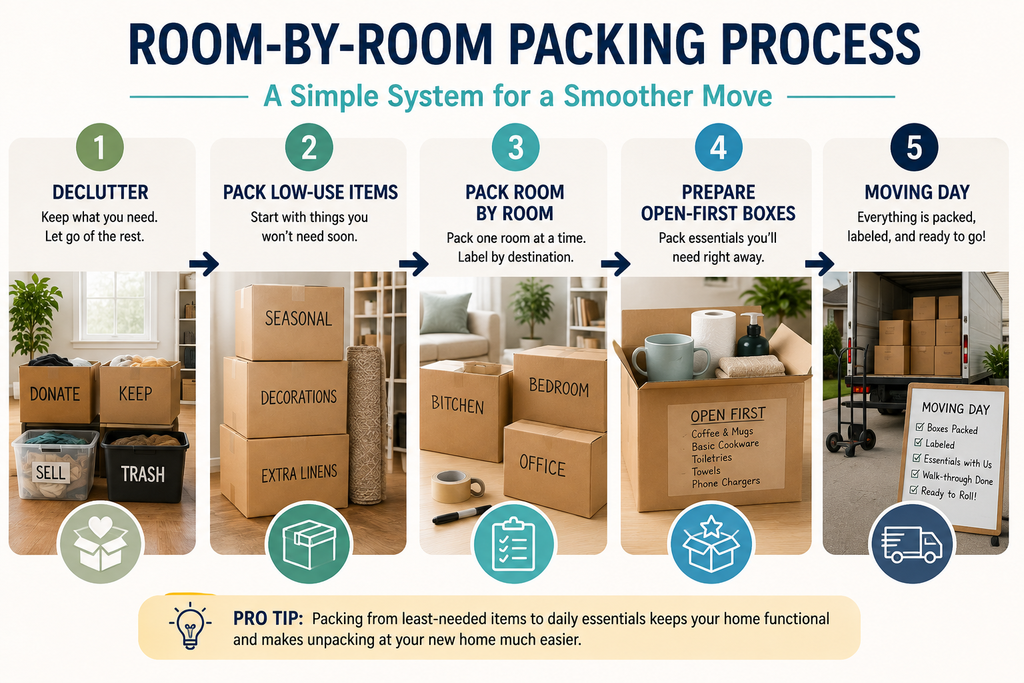
For many households, a practical sequence looks like this:
- First: Storage areas, seasonal items, decor, books, and guest spaces.
- Next: Extra clothing, spare linens, hobby items, and rarely used kitchenware.
- Then: Most bedrooms, living areas, office materials, and remaining nonessentials.
- Final week: Most kitchen supplies, everyday clothing, bathroom items, and electronics.
- Final 24-48 hours: Daily necessities and last-use household items.
- Keep with you: Documents, medications, valuables, devices, chargers, keys, moving paperwork, first-night necessities, and other essentials.
Your exact order may differ. The important thing is to move systematically from least needed to most needed.
Common Packing Mistakes to Avoid
Packing without decluttering
You’re spending time and possibly money transporting things you don’t want.
Making boxes too heavy
A box isn’t successful just because everything fits inside it.
Using vague labels
“Miscellaneous” tells you almost nothing when you’re surrounded by boxes.
Mixing rooms
One box containing kitchen, bedroom, and office belongings creates extra sorting at the destination.
Packing essentials accidentally
Documents, medication, chargers, keys, and first-night supplies should be deliberately separated.
Leaving the kitchen and garage until the end
Both can take substantially more time than their square footage suggests.
Forgetting mover restrictions
Professional movers may prohibit or restrict certain materials. Ask before packing questionable items.
Assuming fragile labels provide protection
Proper wrapping, cushioning, box selection, and limiting movement matter more.
Packing without thinking about unpacking
Every poorly organized box becomes a problem at the destination.
DIY Move vs. Professional Movers: Does Packing Change?
The basic organization doesn’t change much. The responsibility does.
With a DIY move, your household controls packing, loading, transportation, unloading, and much of the risk management. With professional movers, you need to understand which items you’re packing versus which items the company is packing, what the mover will not transport, and how self-packed boxes may affect claims or liability.
For interstate household moves, review FMCSA’s Protect Your Move resources and your mover’s contract, packing terms, valuation options, inventory procedures, and prohibited-items policy.
The Goal Isn’t Perfect Packing. It’s Controlled Packing.
Your home doesn’t need to look like a professionally managed warehouse. You need a system that remains understandable when you’re tired, busy, and surrounded by boxes.
- Reduce what you’re moving.
- Protect what you’re keeping.
- Tell everyone where things belong.
- Make important belongings easy to find afterward.
Work room by room. Pack what you need least first. Label everything consistently. Keep critical belongings with you. Every minute you spend organizing a box before moving day can save you time searching for it after you arrive.
Frequently Asked Questions
What should I pack first when moving?
Start with belongings you won’t need before moving day, such as seasonal decor, books, collectibles, off-season clothing, spare linens, guest-room items, and rarely used kitchen equipment. Gradually work toward everyday essentials as moving day approaches.
How early should I start packing for a move?
There isn’t one correct timeline for every household. The size of your home, amount of belongings, work schedule, family needs, moving method, and available help all matter. Start decluttering and packing low-use belongings early enough that you’re not trying to pack most of your household during the final few days.
What room should I pack first?
Storage spaces, guest rooms, basements, attics, and rooms containing mostly nonessential belongings are often good starting points. Frequently used kitchens and bathrooms usually remain functional longer.
How should I label moving boxes?
At minimum, identify the destination room and general contents. Adding a box number and priority such as OPEN FIRST makes the system more useful.
What should I not pack in the moving truck?
Keep essential documents, medications, keys, devices, chargers, irreplaceable valuables, moving paperwork, and immediate necessities with you. Professional movers may also prohibit hazardous, flammable, perishable, or other restricted items, so obtain your mover’s specific prohibited-items list.
Should I pack room by room?
Generally, yes. Packing and labeling according to destination rooms reduces mixing and makes unloading and unpacking easier. You can still pack rarely used items across the household first while keeping each box assigned to a single destination.
How do I make unpacking easier?
Label boxes by destination room, number them, maintain a basic inventory, identify Open First boxes, and avoid mixing unrelated rooms inside the same box. Pack according to where belongings will live in the new home, not simply where you find them in the old one.
Planning the Entire Move?
Keep More Than Your Packing Organized
The MuvvKit Complete Moving Planner Bundle helps bring your moving timeline, budget, household organization, packing, moving logistics, and other important details together in one structured planning system.
Explore the Complete Moving Planner BundleReferences & Sources
Federal Motor Carrier Safety Administration — Protect Your Move
Consumer guidance for household moves, including preparation, mover responsibilities, inventories, documentation, consumer rights, and moving-day considerations.
FMCSA Protect Your Move
Federal Motor Carrier Safety Administration — Moving Checklist
Federal moving checklist covering preparation, moving day, shipment inventory, delivery, and checking for missing or damaged belongings.
FMCSA Moving Checklist
Federal Motor Carrier Safety Administration — Liability & Protection
Information about interstate mover liability, valuation protection, self-packed boxes, high-value belongings, and loss or damage considerations.
FMCSA Liability & Protection
U.S. Environmental Protection Agency — Household Hazardous Waste
Federal guidance covering household products that may require special handling, storage, recycling, or disposal instead of being treated as ordinary household waste.
EPA Household Hazardous Waste
Ready.gov — Are You Ready? Guide
Federal preparedness guidance regarding protecting critical household, financial, legal, insurance, contact, and other important records.
Ready.gov
Editorial note: MuvvKit provides organizational and educational information on moving. Requirements, mover policies, disposal rules, and transportation restrictions can vary by company, location, item, and type of move. Readers should verify requirements with their mover and applicable federal, state, and local authorities.