How to Hire Professional Movers for a Household Move
Hiring a moving company involves more than comparing prices. Learn how to identify movers and brokers, verify credentials, compare written estimates, understand moving documents and valuation options, recognize warning signs, and prepare for pickup and delivery.

A practical guide to comparing movers, reviewing estimates, verifying credentials, understanding documents, and preparing for moving day.
| QUICK GOAL Choose a professional mover by verifying who will handle the shipment, comparing written estimates for the same scope, understanding the contract and valuation terms, and keeping the move documents organized from estimate through delivery. |
Hiring Movers Is a Selection and Contract Process
Professional movers can handle transportation and may also provide packing, unpacking, storage, specialty-item handling, or other services. Hiring a mover, however, is not simply a matter of choosing a company with an available truck. The process involves defining the work, comparing providers, verifying the company, reviewing estimates and documents, choosing valuation protection, and confirming the details before moving day.
For interstate household moves, federal consumer-protection rules apply to movers and brokers that arrange or transport household goods across state lines. Moves that stay within one state are generally governed by state and local requirements instead, so the agencies, licenses, and consumer rules you need to check can differ.
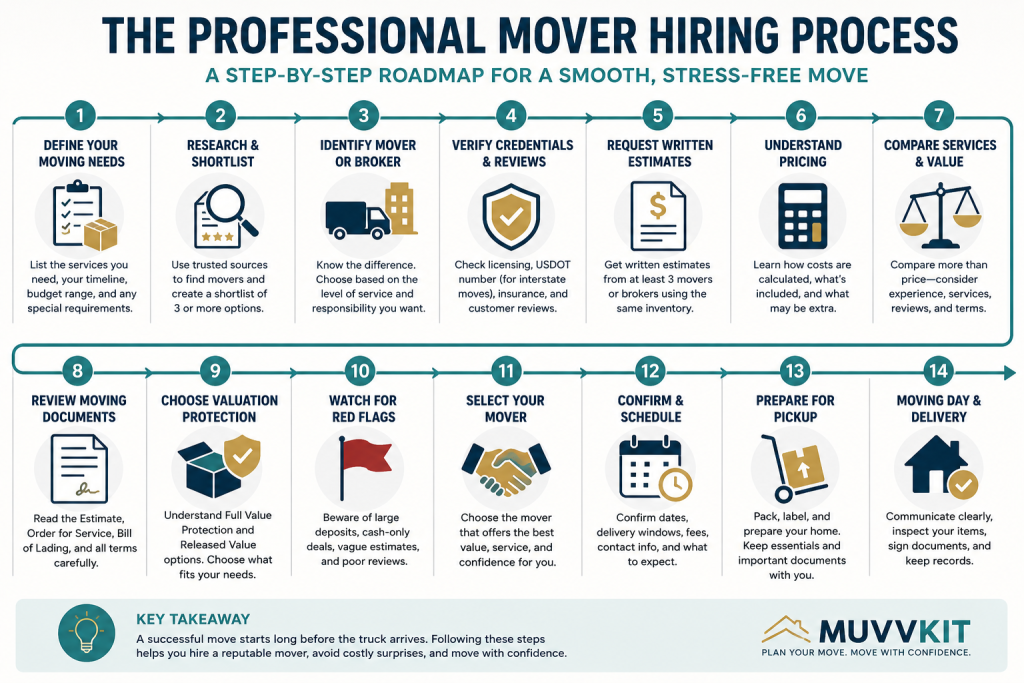
A useful approach is to treat hiring movers as a sequence: define the move, build a shortlist, determine whether each company is a mover or broker, verify credentials, request comparable estimates, review the paperwork, select the service, and reconfirm the move before pickup.
1. Define the Moving Service You Need
Start by deciding what you want the moving company to do. A household move may involve transportation only, loading and unloading, full or partial packing, unpacking, temporary storage, appliance preparation, or handling for specialty items.
List the origin and destination, expected move dates, household size, stairs, elevators, long carries, parking restrictions, large or unusual items, and any services you may need. This information helps companies evaluate the job and makes estimates easier to compare.
Also decide what you intend to handle yourself. For example, you may pack ordinary household goods while asking the mover to pack fragile items. A clear scope reduces confusion when you begin requesting estimates.
You may not need a full-service package to get meaningful assistance. A hybrid moving approach lets you complete manageable tasks yourself while hiring professionals for the parts that require additional equipment, labor, or experience.
2. Build a Shortlist Before Comparing Prices
Gather several candidates rather than selecting the first company that appears in a search result. Recommendations from people you trust can be useful starting points, but they should not replace independent verification.
For an interstate move, do not rely on a single quote. FMCSA’s consumer checklist calls for collecting estimates from three or more movers or brokers. Review the proposed price together with the services each company says it will perform, then verify the interstate provider through FMCSA before choosing one.
Look beyond the headline price. Compare the services offered, communication process, scheduling terms, claims procedures, valuation options, and whether the company itself will transport the shipment.
Price is only one part of a mover comparison. Before making a decision, review what to compare before choosing a moving company, including the services offered, estimate terms, availability, credentials, liability options, and possible additional fees.
3. Determine Whether You Are Dealing With a Mover or a Broker
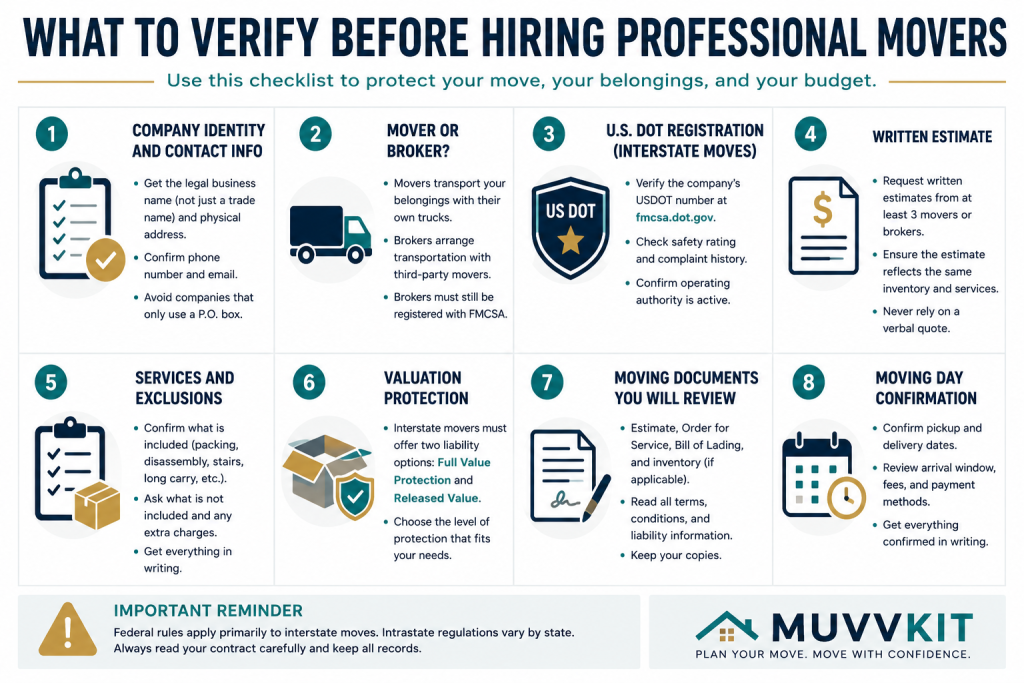
A mover transports household goods. A broker arranges transportation with a mover rather than transporting the shipment itself. The distinction matters because the company that markets or sells the move may not be the company whose truck and crew ultimately handle your belongings.
For interstate moves, both household-goods movers and brokers must be registered with FMCSA. Interstate brokers must also use movers registered with FMCSA and disclose their broker status.
Ask directly whether the company is the motor carrier that will transport the shipment or a broker arranging the service. If it is a broker, ask which movers it uses and when you will know the identity of the carrier assigned to your move.
4. Verify the Company Before You Commit
For an interstate move, verify the mover or broker through FMCSA rather than relying only on a company website, advertisement, review platform, or salesperson. Interstate movers need a U.S. DOT number, and FMCSA provides a search tool for registration and complaint-history information.
Confirm that the business name, U.S. DOT number, contact information, and operating status match the company you are considering. If a broker is involved, verify the broker as well as the carrier when the carrier is identified.
For an intrastate move, federal interstate registration rules may not apply. Check the licensing and consumer-protection requirements for the state where the move occurs. State attorneys general, state transportation agencies, public utility commissions, or consumer-affairs offices may be relevant depending on the state.
5. Request Written Estimates That Describe the Same Move
An estimate is most useful when each company is pricing the same shipment and services. Give each mover substantially the same inventory, access information, dates, and requested services. Disclose stairs, elevators, long carries, difficult parking, bulky items, and anything else that could affect the work.
For interstate moves, FMCSA says the mover must provide a written estimate of the charges. The estimate should be based on an actual or virtual inspection of the household goods rather than treated as a casual rate quote.
Compare what is included as well as the total. One estimate may include packing materials, shuttle service, storage, or other charges that another estimate excludes. A large difference in price is a reason to examine the scope and assumptions, not automatically a reason to choose the lowest number.
Once the company is selected, use a moving day checklist for working with professional movers to organize the arrival briefing, paperwork review, inventory checks, and final walkthrough.
6. Understand Binding and Non-Binding Estimates
For interstate moves, a binding estimate is a written agreement that fixes the cost based on the quantities and services listed in the estimate. If you add goods or request additional services, the mover may need to prepare a revised estimate.
A non-binding estimate is a planning figure, not a promise that the final bill will match it. For an interstate shipment, the amount ultimately charged can change with the shipment’s actual weight and the services performed under the mover’s tariff. Federal payment rules also limit what can ordinarily be demanded at delivery when the move began with a non-binding estimate; qualifying additional charges can be billed later. Read the estimate and payment terms so you know when each amount may become due.
Do not treat the words binding and non-binding as minor paperwork details. They affect how the final charge is calculated and what may be collected at delivery.
Compare Moving Companies Side by Side
Once you have several estimates, keep the details organized in one place. Use the MuvvKit Mover Comparison Workbook to compare pricing, services, company information, estimate terms, valuation options, and other important details before choosing a mover.
Explore the Mover Comparison Workbook7. Compare Services, Exclusions, and Possible Extra Charges
Read each estimate line by line. Identify what the mover will pack, disassemble, load, transport, store, reassemble, and unload. Then identify what is excluded.
Ask how the company handles conditions that may add work or cost. Examples can include stairs, elevators, long carries, shuttle vehicles, bulky items, storage, waiting time, packing materials, or access problems. The exact terminology and charges vary by mover and move.
Tell the mover when the shipment or access conditions change. Adding furniture, changing addresses, changing dates, or requesting new services can affect the estimate and the contract.
The mover’s estimate may not represent the full cost of the relocation. Before accepting a quote, review the moving costs people often forget to include in their budget so you can account for expenses outside the moving company’s services.
8. Review the Required Documents Before Signing
For an interstate move, FMCSA requires movers and brokers to provide consumer information, including the booklet Your Rights and Responsibilities When You Move and the Ready to Move brochure. Read these materials before the move rather than saving them for a problem later.
Review the written estimate, order for service when applicable, bill of lading, inventory, valuation selection, and other documents provided for your shipment. Make sure the documents describe the move you agreed to and do not sign forms you do not understand.
Keep copies of everything in one accessible place. Do not pack the contract, estimate, inventory, identification, payment information, or important contact details inside the moving truck.
9. Understand Valuation Protection Before Moving Day
Before choosing protection for an interstate shipment, separate two concepts that are often confused. The mover’s valuation selection sets its contractual responsibility if household goods are lost or damaged. That protection is different from a separate insurance policy. Federal rules give interstate customers a choice between the more comprehensive Full Value Protection level and the limited Released Value option.
With Full Value Protection, a covered loss can require the mover to repair an item, replace it with a comparable item, or make an appropriate cash settlement, subject to the governing terms and any applicable limitations. Released Value does not add a valuation charge, but compensation is based on the item’s weight rather than its retail or replacement price, so the available recovery can be very small.
Ask for the mover’s written valuation details before making a selection, especially if the shipment contains unusually valuable articles that may need to be listed separately. You can also review your own homeowners or renters policy and investigate third-party coverage if appropriate. Coverage varies, so confirm the terms instead of assuming that a household policy, outside policy, or mover valuation selection protects every loss.
10. Look for Warning Signs Before Paying or Signing
Be cautious when important information is difficult to verify, the company will not provide a written estimate, the business identity changes during the process, or the company pressures you to sign before you understand the documents.
For interstate moves, verify registration and complaint information through FMCSA. Be especially careful if a company represents itself as a mover but is actually acting as a broker without clearly disclosing that role.
A low estimate by itself does not prove that a company is unreliable. The better question is whether the price, company identity, services, registration, documents, and explanations are consistent and verifiable.
11. Choose the Mover Based on the Whole Agreement
After comparing candidates, evaluate the complete arrangement rather than ranking companies by price alone. Consider the verified company identity, scope of work, estimate type, timing, valuation options, payment terms, communication, and your understanding of the contract.
Before accepting, make sure you know who will transport the shipment, how to contact the company during the move, what dates or delivery windows apply, what payment methods are accepted, and what happens if the shipment or schedule changes.
Keep the selected estimate and related documents together. Record the mover’s U.S. DOT number for an interstate move and save the names and phone numbers of your primary contacts.
Once the mover is selected, organize the current estimate, service records, bill of lading, inventory, valuation choice, and contact details. The guide to moving company paperwork to keep accessible explains when those records may be needed on moving day.
12. Confirm the Move Before Pickup
Reconfirm the dates, addresses, access conditions, parking, elevators, inventory changes, packing responsibilities, and any specialty items before moving day. If something has changed, tell the mover before loading begins so the paperwork can be updated when required.
Prepare the home so the crew can work efficiently. Finish the packing you agreed to handle, separate items that will travel with you, label boxes clearly, and keep children and pets away from active work areas.
Have the estimate, contract documents, inventory, identification, payment method, and contact information accessible. If you cannot be present at pickup or delivery, arrange for an authorized representative and make sure that person understands the move documents.
Keep Moving Day Details Organized
Once your mover is booked and the details are confirmed, the next step is coordinating moving day. Use the MuvvKit Moving Day Command Sheets to keep schedules, mover contacts, access details, loading notes, payments, inventory checks, and other important moving-day information together.
Explore the Moving Day Command Sheets13. Stay Involved During Pickup and Delivery
Professional movers handle the physical work covered by the agreement, but you still have responsibilities as the shipper. Be available to answer questions, review documents, and identify changes.
At pickup, review the mover’s inventory and note the condition information before signing. Keep your copy. At delivery, use the inventory and your own records to help identify missing or visibly damaged items.
Do not allow important documents, medications, keys, identification, irreplaceable personal records, or other keep-with-you essentials to be loaded accidentally. Keep those items physically separated from the shipment.
14. Keep Records After the Move
Save the final bill, bill of lading, inventory, estimates, payment records, photographs, correspondence, and any damage documentation. These records can matter if you need to question a charge or file a claim.
If goods are lost or damaged, follow the mover’s claims procedures and applicable deadlines. For interstate moves, the FMCSA consumer materials explain federal rights, responsibilities, complaint resources, and dispute-settlement information.
Once the transportation portion is complete, transition into unpacking and settling in. Keeping the mover paperwork together until the shipment has been checked can make follow-up easier.
Common Mistakes When Hiring Professional Movers
Choosing only by the lowest estimate. A price comparison is useful only when the companies are estimating the same shipment and services.
Failing to verify the company. A professional-looking website does not establish interstate operating authority. Use the appropriate official registration source.
Confusing a broker with a mover. Know whether the company will transport the shipment or arrange for another company to do it.
Leaving access details out of the estimate. Stairs, elevators, long carries, parking restrictions, and shuttle needs can affect the work and cost.
Signing without reading the documents. Estimates, valuation selections, inventories, and bills of lading affect your rights, responsibilities, and charges.
Packing moving documents into the truck. Keep contracts, inventories, identification, payment information, and contact details with you.
Failing to report changes. Added items, new services, changed addresses, or changed access conditions can require updated pricing or documents.
A Simple Professional-Mover Hiring Sequence
1. Define the move and the services you want.
2. Build a shortlist of several companies.
3. Identify whether each company is a mover or broker.
4. Verify interstate registration or applicable state credentials.
5. Give each candidate the same inventory and access information.
6. Obtain and compare written estimates.
7. Review binding or non-binding terms and possible extra charges.
8. Read the mover’s documents and valuation options.
9. Select the company based on the full agreement, not price alone.
10. Reconfirm dates, access, inventory, and services before pickup.
11. Keep documents and essentials with you during the move.
12. Review the shipment at delivery and retain records afterward.
The goal is not to eliminate every uncertainty from a household move. It is to make the important decisions before your belongings are loaded. A verified company, a clearly defined scope, comparable estimates, understood documents, and organized records give you a stronger basis for managing a professional move.
Frequently Asked Questions
How many moving estimates should I get?
For an interstate move, use multiple written estimates rather than treating one company’s proposal as the market benchmark. FMCSA’s checklist sets three movers or brokers as the minimum comparison set. Looking at several proposals side by side makes differences in scope, pricing assumptions, and included services easier to spot.
How do I check whether an interstate mover is legitimate?
Use FMCSA’s official mover search resources to check registration, U.S. DOT information, and complaint history. Confirm that the company information matches the business you are dealing with.
What is the difference between a moving company and a moving broker?
A mover transports your household goods. A broker arranges transportation with a mover. Interstate movers and brokers have different roles, and both must meet applicable FMCSA registration requirements.
Should I choose a binding or non-binding estimate?
Neither type is automatically best for every move. A binding estimate fixes the price for the listed shipment and services, while a non-binding estimate is an approximation whose final charge can depend on actual weight and services. Compare the terms and understand how changes will be handled.
What should I keep with me on moving day?
Keep identification, medications, keys, important documents, mover paperwork, payment information, phones and chargers, valuables that should not be shipped, and immediate travel or first-night essentials accessible.
Does FMCSA regulate every household move?
Originality note: Federal moving rules and standardized industry terms necessarily use names such as Full Value Protection, Released Value, U.S. DOT number, and binding or non-binding estimate. The explanatory prose in this article is independently written; official terminology is retained only where changing it would reduce accuracy.
No. FMCSA’s household-goods consumer regulations apply to interstate and certain foreign-commerce moves by motor vehicle. Moves entirely within one state are generally subject to state and local rules instead.
Organize the Rest of Your Move
Hiring your movers is only one part of planning a household move. The MuvvKit Complete Moving Planner Bundle brings your timeline, budget, household planning, packing, moving-day details, and other essential moving information together in one organized system.
Explore the Complete Moving Planner BundleReferences & Sources
Federal Motor Carrier Safety Administration (FMCSA),
- Protect Your Move
https://www.fmcsa.dot.gov/protect-your-move
General federal consumer guidance for interstate household-goods moves, including required documents, preparation resources, and consumer rights. - Steps to Select a Mover
https://www.fmcsa.dot.gov/protect-your-move/select-mover
Covers written estimates, verification of interstate authority and insurance, and the use of FMCSA’s mover-search resources. - Movers vs. Brokers
https://www.fmcsa.dot.gov/protect-your-move/movers-vs-brokers
Explains the difference between a household-goods mover and a broker, including interstate registration requirements. - Moving Checklist
https://www.fmcsa.dot.gov/protect-your-move/moving-checklist
Includes FMCSA’s recommendation to obtain estimates from at least three movers or brokers and compare costs and services. - What Is a Binding Move Estimate?
https://www.fmcsa.dot.gov/consumer-protection/protect-your-move/what-binding-move-estimate
Explains written estimates, binding estimates, non-binding estimates, and the federal 110% collection rule for non-binding estimates at delivery. - Liability & Protection
https://www.fmcsa.dot.gov/consumer-protection/protect-your-move/are-you-moving/liability-protection
Explains the federal valuation options available for interstate household-goods moves, including Full Value Protection and Released Value. - Protect Your Move Toolkit
https://www.fmcsa.dot.gov/protect-your-move-toolkit
Provides official consumer resources including the Rights and Responsibilities handbook, Ready to Move brochure, mover/broker materials, valuation information, and moving checklist.
Editorial note: This article provides general educational information for U.S. household moves. Interstate household-goods moves are subject to federal requirements, while intrastate requirements vary by state and locality. Verify current rules and the credentials, terms, and documents that apply to your specific move.