How to Plan a DIY Move: A Complete Guide for Moving Yourself
Planning to move yourself? This complete DIY moving guide explains how to organize your timeline, budget, household inventory, rental vehicle, equipment, helpers, packing, loading, driving, unloading, and moving day so each part of the move is planned before the physical work begins.
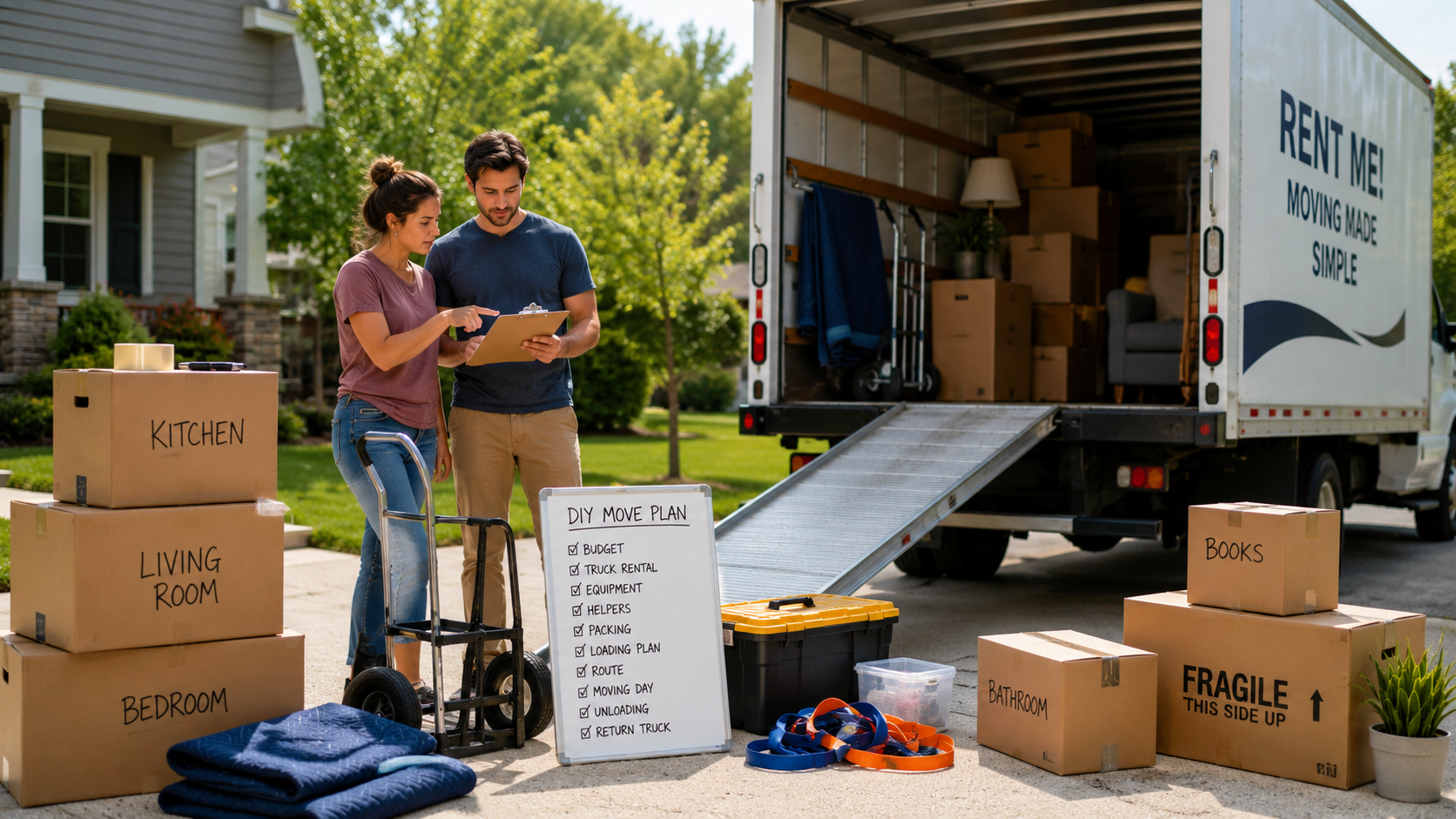
A practical system for planning the truck, equipment, helpers, packing, loading, driving, unloading, and return of rental equipment.
| QUICK GOAL Treat a DIY move as a coordinated logistics project: know what must be moved, choose enough vehicle capacity, gather the right equipment, assign realistic roles, build a safe loading plan, and leave enough time for unloading and cleanup. |
A DIY Move Is More Than Renting a Truck
A DIY move usually means you take responsibility for most or all of the physical move instead of hiring a full-service moving company. You may rent a box truck or trailer, use your own vehicles, or ask friends or family to help. You can also hire labor-only help for selected tasks. The defining feature is that you remain the person coordinating the move.
That control can be useful, but it also shifts the operational decisions to you. You need to estimate how much you are moving, reserve transportation, obtain equipment, and organize helpers. You also need to prepare the home, plan the load, protect belongings in transit, manage transportation, unload, and return rented equipment on time.
A DIY move still requires accessible records, even when no professional mover is involved. Review the documents needed for a DIY move, including the rental agreement, equipment inspection, driver authorization, roadside contacts, access details, receipts, and household inventory.
The easiest way to make a self-move manageable is to plan it in layers. First decide whether the method fits your household. Then build the timeline and budget. After that, plan the physical work: packing, equipment, helpers, loading, travel, unloading, and contingencies.
1. Decide Whether a DIY Move Fits the Move
Before reserving a truck, look at the move itself. A small local move from an apartment is a different project from moving a furnished house several states away. Several factors determine whether moving yourself is practical. Consider the distance, household size, stairs, parking, large furniture, driving conditions, available helpers, physical limitations, and available time.
Pay special attention to items that are unusually heavy, fragile, valuable, or difficult to maneuver. Pianos, safes, oversized appliances, large glass pieces, and bulky furniture may require equipment or experienced handling even if the rest of the move is self-managed.
A DIY move also does not have to mean doing every task personally. You can keep control of the move while paying for a specific service such as loading labor, unloading labor, specialty-item handling, or temporary storage. If the plan becomes unrealistic, a hybrid or professional-moving method may be a better fit.
A DIY move doesn’t require you to handle every job personally. If loading, transportation, specialty items, or heavy furniture create problems, consider combining DIY moving with professional help while keeping the remaining work under your control.
Keep your dates, tasks, expenses, contacts, and moving-day information organized in one place with the DIY Moving Planner
2. Build the DIY Moving Timeline Before You Book
Work backward from the date you need to leave the old home and the date you can enter the new one. Mark any fixed deadlines first: lease end, closing, elevator reservation, building move hours, truck pickup, helper availability, utility changes, travel days, and rental return.
Then add the preparation work that must happen before loading day. That includes decluttering, measuring large furniture, and creating a household inventory. You also need to gather packing supplies, pack by room, disassemble furniture, confirm parking, and prepare your keep-with-you essentials.
Avoid placing every unfinished task in the final two or three days. A self-move already requires more attention on moving day because you are managing both people and equipment. The more packing and decision-making you finish early, the more capacity you have for the physical move itself.
3. Create a Realistic DIY Moving Budget
The truck or trailer quote is only one part of the cost. Build a budget that captures the full method so you can compare it fairly with other moving options.
Start with the vehicle rental, mileage or distance charges, fuel, tolls, and any insurance or protection products. Then account for equipment and supplies such as moving blankets, dollies, hand trucks, straps, boxes, tape, and mattress protection. Other costs may include parking permits, labor-only help, storage, lodging, meals, and possible late-return or cleaning charges. Read the rental terms carefully because pricing and included mileage vary by company, location, vehicle, route, and date.
Keep receipts and rental documents together. Federal tax treatment of moving expenses is limited and has changed over time. For 2026, the IRS says qualifying active-duty Armed Forces members and certain Intelligence Community employees may receive special moving-expense treatment under applicable rules; most household moves do not qualify for a federal moving-expense deduction. Check current IRS guidance or a qualified tax professional for your situation.
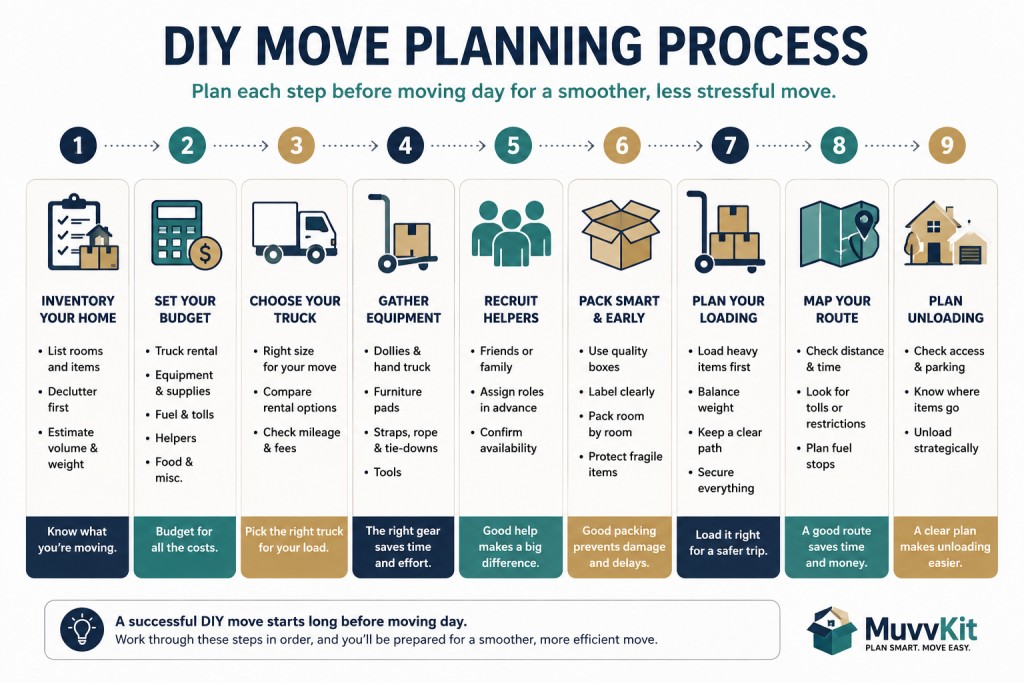
4. Inventory What You Are Actually Moving
Truck-size decisions become easier when they are based on the household you actually plan to move rather than a rough guess based only on the number of bedrooms. Walk through every room, closet, storage area, garage, basement, attic, balcony, and outdoor space.
List large furniture, appliances, awkward pieces, and unusually dense groups of boxes such as books. Identify items that will be sold, donated, discarded, carried in a personal vehicle, or moved separately. Measure large pieces and the narrowest doors, stair turns, elevators, gates, and hallways they must pass through.
Your inventory does not need to record every fork and towel. Its job is to help you estimate volume, plan disassembly, identify equipment needs, and prevent forgotten storage areas from changing the move at the last minute.
5. Choose the Moving Vehicle and Understand Its Limits
Once the inventory is reasonably stable, compare vehicle options. Rental companies may describe trucks by length, household size, or estimated room capacity. Treat those descriptions as planning aids rather than guarantees. Your actual load depends on furniture dimensions, box sizes, packing density, and how efficiently the cargo can be arranged.
Check more than cargo space. Review the vehicle’s payload or weight limits, dimensions, clearance height, fuel type, pickup and return rules, mileage terms, towing restrictions, and driver requirements. If you plan to tow a trailer or vehicle, confirm that the tow vehicle, hitch, trailer, and combined load are within the manufacturer’s ratings and the rental provider’s requirements.
Do not plan to solve a capacity problem by overloading the vehicle. If the load will not fit safely, reduce the shipment, use another vehicle, make another trip when practical, or change the moving method.
6. Reserve Equipment and Supplies for the Physical Work
Boxes and tape are only part of a DIY move. Think about how the heaviest and most awkward items will travel from their current position to the truck and from the truck into the new home.
Depending on the household, useful equipment may include a furniture dolly, appliance dolly, hand truck, moving blankets, lifting or carrying straps, tie-down straps, mattress bags, stretch wrap used appropriately, furniture pads, basic hand tools, work gloves, and floor protection. Use equipment according to its instructions. Do not rely on improvised lifting methods when a load exceeds what the people or equipment can safely handle.
Confirm what comes with the rental vehicle and what must be reserved separately. Equipment availability can differ by location, so include it in the reservation rather than assuming it will be available at pickup.
7. Organize Helpers by Role, Not Just Headcount
A group of helpers is most useful when everyone knows what they are responsible for. Before moving day, confirm who is actually available, what time they will arrive, how long they can stay, and whether anyone has limitations that affect lifting or stairs.
Assign simple roles. One person can coordinate inside the home, one can manage the truck and loading sequence, and others can carry or use dollies. For large pieces, designate one person to give directions so several people are not calling conflicting instructions at the same time.
Have a backup plan if a helper cancels. That may mean reducing what must be moved that day, booking labor if available, changing the loading sequence, or allowing more time. A plan that depends on every volunteer arriving exactly on time is fragile.
Organize Your DIY Move in One Place
A DIY move involves more than packing boxes. Keep your truck planning, equipment, helpers, loading strategy, route, moving-day tasks, unloading, and DIY moving costs organized with the MuvvKit DIY Moving Planner.
Explore the DIY Moving Planner8. Pack for Loading, Not Just for Storage
Packing affects how safely and efficiently a DIY truck can be loaded. Use boxes that can close fully, reinforce them as appropriate, and avoid making large boxes excessively heavy. Label each box with its destination room and enough information to identify fragile or priority contents without advertising valuables.
Prepare furniture before moving day when possible. Empty drawers when weight or construction makes that appropriate, secure loose parts, bag and label hardware, protect finished surfaces, and disassemble pieces that cannot pass safely through doors or stairs.
Keep essential personal items out of the main shipment when appropriate. These may include identification, medications, keys, wallets, documents, chargers, sensitive electronics, irreplaceable valuables, travel supplies, and first-night necessities. Place them in a clearly separated no-load area or personal vehicle so they do not disappear into the truck.
Assign the driver, loading lead, pathway monitor, and final-walkthrough checker before work starts. The complete DIY moving day checklist organizes those roles from morning preparation through vehicle return and move-day closeout.
9. Make a Truck-Loading Plan Before the First Box Moves
Loading should not be improvised one item at a time. Decide which rooms or staging zones will feed the truck first and which items need to be accessible at the destination. Think about weight, stability, shape, and how pieces can be secured against movement.
The exact loading arrangement depends on the vehicle and the cargo, so follow the rental provider’s and vehicle manufacturer’s instructions. In general, avoid unstable stacks, protect items from hard contact, and secure cargo so it cannot shift, fall, or escape during transport. The National Highway Traffic Safety Administration advises drivers to tie down cargo, avoid excessive loads, and double-check that the load is secure before driving.
Do not block access to items you will need during the trip, and do not put documents, medications, keys, or other keep-with-you essentials deep inside the cargo area.
10. Plan the Route as a Loaded-Vehicle Trip
Driving a loaded box truck or towing a trailer is different from driving an ordinary passenger vehicle. Plan the route with the actual vehicle in mind. Check the rental vehicle’s dimensions and restrictions, and pay attention to clearance, parking, toll arrangements, steep grades, construction, and any roads where the vehicle or trailer may not be appropriate.
Allow more space and time for turns, braking, merging, and parking. Follow the rental company’s operating instructions and all applicable traffic laws. If you are uncomfortable with the selected vehicle or towing configuration, address it before moving day. Do not assume the problem will disappear once the truck is loaded.
For a long-distance move, decide where you can safely stop, refuel, eat, and rest. Keep the rental agreement, roadside-assistance information, route notes, and destination access details where the driver can reach them.
11. Prepare Both Homes for Moving Day
At the origin, clear hallways and stairs, protect vulnerable floors where appropriate, open gates, reserve elevators if required, and move vehicles that block the loading path. Confirm where the rental truck can legally and safely park. Keep children and pets away from active carrying routes.
At the destination, know how you will get the vehicle close enough to unload, where boxes should go, and whether there are building rules or time limits. Label rooms before unloading if the layout is unfamiliar. A simple room map can keep helpers from asking where every box belongs.
If access at either home is difficult, solve that problem before the truck arrives. Difficult access can significantly affect the move. Long carries, stairs, narrow doors, elevators, restricted parking, and steep driveways can all require additional time or labor.
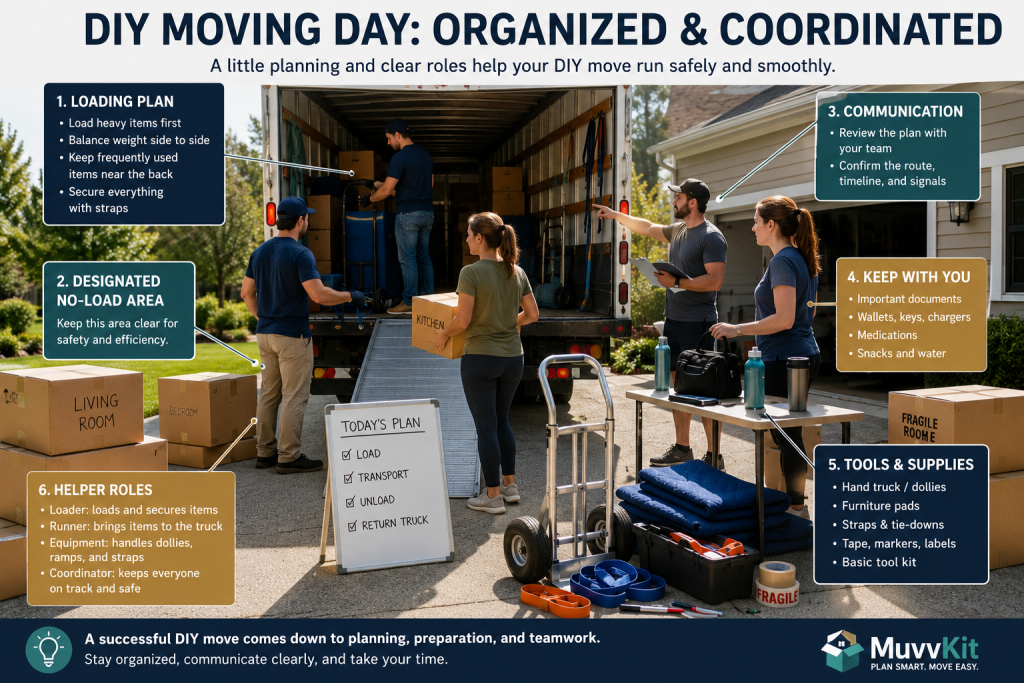
12. Run Moving Day From a Simple Command Plan
Start with a short briefing. Show helpers the no-load area, explain the loading order, identify fragile or unusually heavy items, review the path to the truck, and confirm who is directing the load. Keep water, basic first aid supplies, phones, chargers, tools, and important documents accessible.
As the truck fills, check that cargo remains stable and secured. Do not rush a lift or stack simply because the schedule is slipping. Stop and change the plan if an item cannot be moved safely with the people and equipment available.
Before leaving, walk through every room and storage area. Check cabinets and closets, collect keys or access devices, and verify that nothing intended for the move remains behind. Photograph the property’s condition when useful. At the destination, direct items to their rooms, check for obvious damage, and keep pathways clear as boxes accumulate.
If you are still deciding which responsibilities to handle yourself, start with this complete guide to planning a DIY move before building your schedule.
13. Finish the Move Before You Consider It Done
A DIY move continues after the last box crosses the doorway. Reassemble only what you need immediately, create safe walking paths, and keep tools and hardware organized. Check the rental vehicle for belongings, debris, and damage before returning it. Follow the provider’s requirements for fuel, cleaning, return location, and return time.
Save the final receipt, rental agreement, fuel receipts, toll records, and any documentation related to damage or roadside issues. If you used hired labor or another service for part of the move, retain those records as well.
Then shift from moving-day operations to settling in: unpack priority rooms, update addresses and accounts, set up utilities and safety basics, and work through the remaining boxes in a deliberate order rather than trying to finish everything immediately.
Common DIY Moving Mistakes to Avoid
Underestimating the amount of belongings. A truck chosen before decluttering or inventorying can create a capacity problem on moving day.
Treating the rental quote as the total budget. Fuel, mileage, equipment, supplies, tolls, labor, travel, and return conditions can materially change the final cost.
Waiting until moving day to test access. Furniture that cannot clear a stair turn or a truck that cannot park where expected can stall the entire move.
Depending on unconfirmed helpers. Build the plan around people who have actually committed and keep a fallback option.
Avoid Loading and Packing Problems
Loading without a system. Random loading can waste space, create unstable stacks, bury needed items, and make unloading harder.
Ignoring cargo security. A loaded vehicle must be operated with the cargo safely contained and secured. NHTSA notes that unsecured loads can create dangerous roadway hazards.
Packing essentials into the shipment. Keep-with-you items should be physically separated before loading starts.
A Simple DIY Move Planning Sequence
If the full project feels complicated, reduce it to this order:
1. Decide whether a self-move fits your distance, household, access, time, and physical workload.
2. Set the move dates and major deadlines.
3. Declutter and inventory the household.
4. Build the full DIY budget.
5. Choose and reserve the vehicle and equipment.
6. Confirm helpers or hired labor and assign roles.
7. Pack, label, measure, and disassemble before moving day.
8. Plan the loading sequence and keep-with-you items.
9. Prepare the route and both properties.
10. Load carefully, secure the cargo, and complete a final walkthrough.
11. Unload by room and return rental equipment according to the agreement.
12. Save records and transition into unpacking and settling in.
The goal is not to make a DIY move effortless. It is to remove avoidable uncertainty. When the vehicle, people, equipment, load, route, and deadlines have all been planned before moving day, you can spend the day executing decisions instead of making every decision under time pressure.
Frequently Asked Questions
How far in advance should I plan a DIY move?
Start as early as your move allows, especially when you need a rental truck, elevator reservation, parking permit, or specific helpers. The planning sequence matters more than a fixed number of weeks: decide the method, inventory the household, reserve critical resources, then complete packing and access preparation before moving day.
Is a DIY move always cheaper than hiring movers?
No. A DIY move can reduce the amount you spend on paid labor. However, the final cost also depends on the truck, mileage, fuel, equipment, supplies, travel, hired help, and the size and distance of the move. Compare the full expected cost rather than only the advertised vehicle rate.
How do I know what size moving truck I need?
Use your actual household inventory and the rental provider’s sizing guidance. Bedroom-count estimates are only a starting point. The amount of space you need depends on more than bedroom count. Large furniture, dense boxes, unusual items, and loading efficiency can all affect capacity. Do not exceed vehicle weight or payload limits.
Can I hire movers just to load or unload a rental truck?
Often, yes. Labor-only moving services are one way to create a hybrid move while you remain responsible for transportation. Availability, licensing requirements, insurance, and service terms vary, so verify the provider and understand exactly what the service includes.
What should I keep with me during a DIY move?
Keep identification, medications, keys, wallets, important documents, phones and chargers, sensitive or irreplaceable valuables, immediate travel supplies, and first-night essentials accessible rather than buried in the main load.
What is the most important safety rule when loading a moving truck?
Always follow the instructions for the specific vehicle and rental equipment you use. Keep the cargo within applicable weight limits and secure it so it cannot shift or escape during transportation. Use appropriate equipment and stop if a lift or loading decision cannot be completed safely.
Keep Planning Your DIY Move
Once your DIY moving plan is in place, the next steps are getting your household packed and preparing for moving day. Continue with MuvvKit’s step-by-step guides for each stage.
References & Sources
National Highway Traffic Safety Administration (NHTSA), Drive Safe: Secure Your Load. https://www.nhtsa.gov/drive-safe-secure-your-load
Federal Motor Carrier Safety Administration (FMCSA), Protect Your Move. https://www.fmcsa.dot.gov/protect-your-move
Federal Motor Carrier Safety Administration (FMCSA), What is an interstate move? https://www.fmcsa.dot.gov/consumer-protection/protect-your-move/are-you-moving/what-interstate-move
Internal Revenue Service (IRS), Topic No. 455, Moving Expenses for Members of the Armed Forces and the Intelligence Community. https://www.irs.gov/taxtopics/tc455
| Editorial note: This article provides general educational information for U.S. household moves. Rental terms, vehicle requirements, towing rules, parking rules, and state or local requirements vary. Follow the instructions for the specific vehicle and equipment you use and verify current requirements that apply to your move. |