Hybrid Moving: How to Combine DIY Moving With Professional Help
A hybrid move combines DIY moving with selected professional services. Learn how to divide packing, loading, transportation, unloading, equipment, schedules, costs, and responsibilities so the separate parts of your household move work together as one coordinated plan.
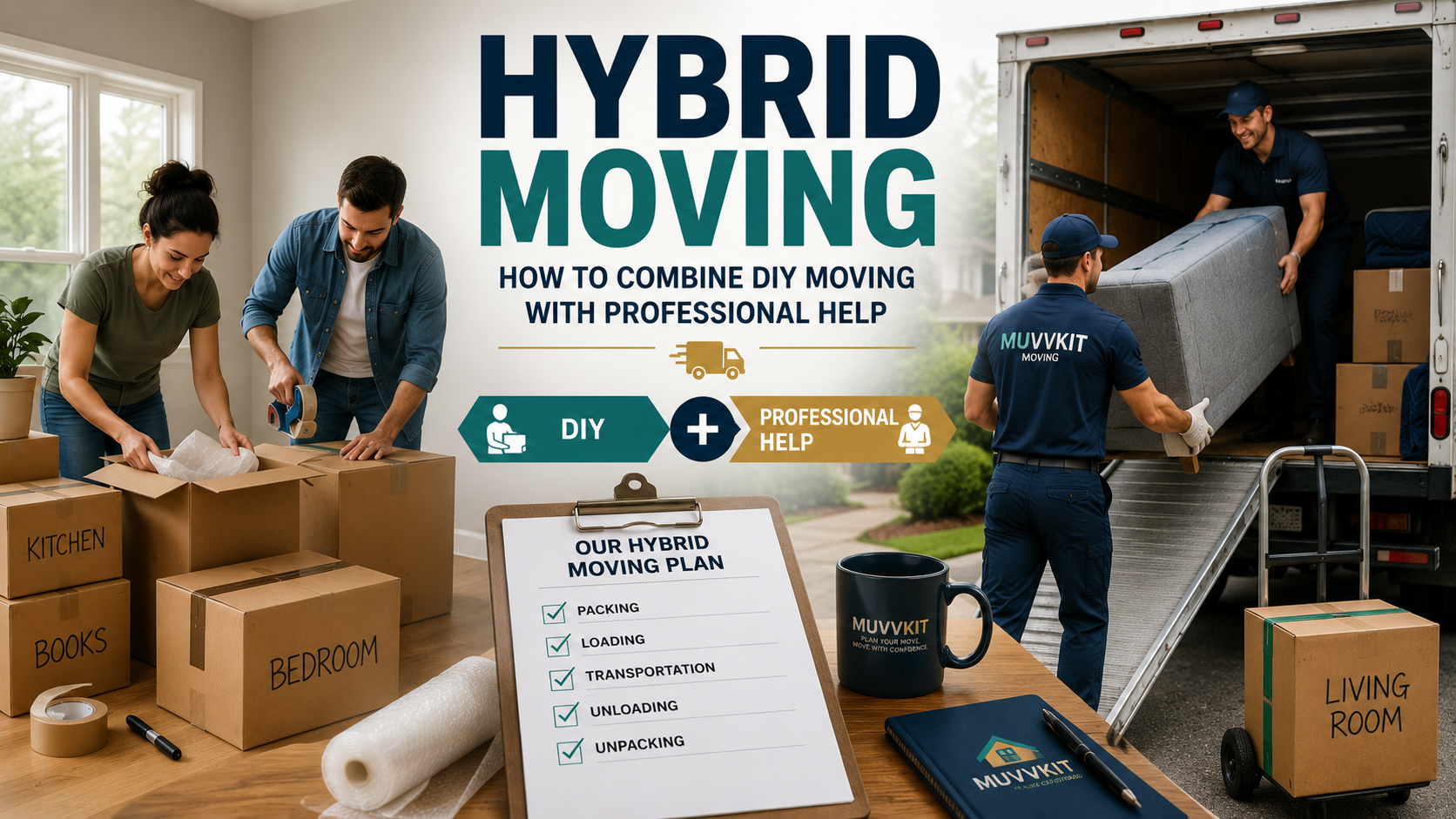
A practical guide to dividing a household move between the work you manage yourself and the services you hire.
| QUICK GOAL Build one coordinated moving plan even when different parts of the move are handled by different people. Decide which tasks you will manage, which tasks you will hire out, who controls transportation, where responsibility changes hands, and how every service fits the same timeline. |
What Is a Hybrid Move?
A hybrid move combines do-it-yourself work with paid moving help. Instead of choosing between doing everything yourself and hiring a full-service mover, you divide the move into separate tasks and decide who should handle each one.
One household might pack its own boxes and hire a mover for loading, transportation, and unloading. Another might rent and drive a truck but hire labor at each home. A third might use a portable moving container, handle the packing, and pay for help with heavy furniture. The exact combination depends on the household, distance, budget, access, schedule, and physical workload.
The important point is that hybrid moving is not a single standardized service. It is a planning method. You remain responsible for making sure the separate parts work together.
1. Start With the Entire Move, Not the Services
Before booking labor, a truck, a container, or a moving company, map the move from the old home to the new one. Identify the move dates, origin and destination access, household inventory, large or specialty items, travel plan, and any fixed deadlines.
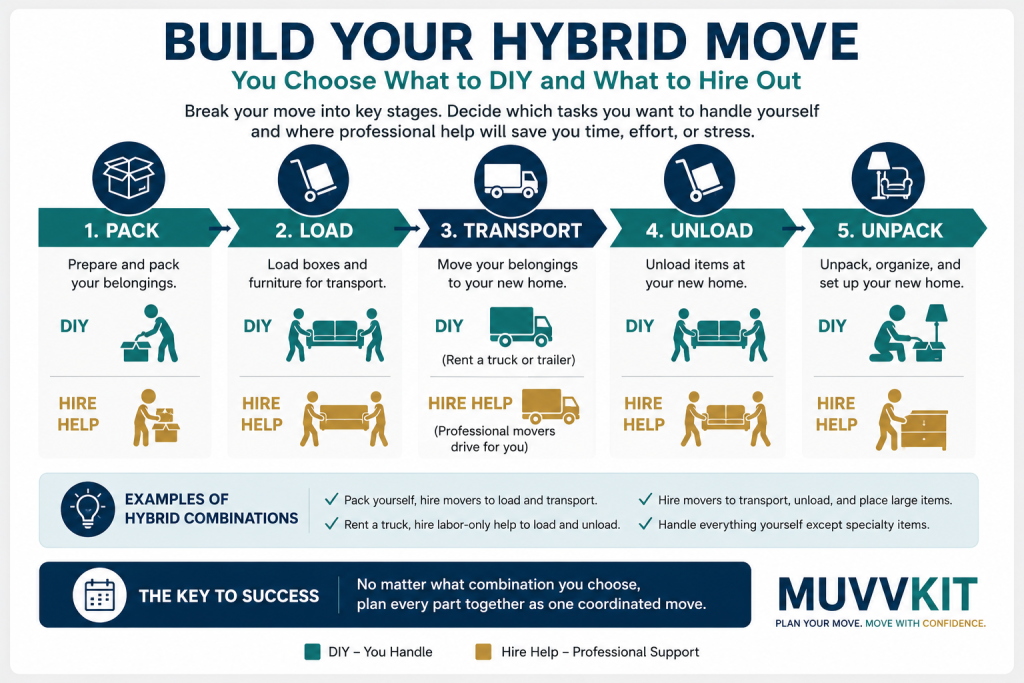
Then divide the project into major functions: packing, disassembly, loading, transportation, unloading, reassembly, storage, and unpacking. This makes it easier to see which tasks can stay DIY and where professional help may be useful.
Planning the whole move first also prevents a common hybrid problem: purchasing several individual services that do not actually connect into a workable schedule.
2. Decide What You Can Realistically Do Yourself
DIY work can reduce the amount of paid service, but it still requires time, equipment, physical capacity, and coordination. Evaluate each task separately instead of assuming that everything outside transportation should automatically be DIY.
Packing ordinary household goods may be manageable over several weeks. Moving a heavy safe down stairs may not be. Driving a rental truck across town may feel reasonable, while driving a large vehicle across several states may not.
Consider the people available to help, their physical limitations, the property layout, the amount of furniture, the distance, and the time available. A hybrid plan works best when DIY tasks are assigned because they fit the household, not simply because they appear cheaper.
Whether a task will be completed by your household or by hired help, record the assignment and deadline in the DIY Moving Planner so responsibilities remain clear.
3. Identify the Tasks That May Benefit From Professional Help
Professional help can be used selectively. Common examples include packing fragile or specialty items, loading a rental truck, unloading at the destination, moving unusually heavy furniture, providing transportation, or handling temporary storage.
Labor-only services are one hybrid option. In this arrangement, you typically remain responsible for the transportation while hired workers provide physical labor such as loading or unloading. Commercial labor marketplaces also advertise packing, unpacking, cleaning, and heavy-lifting services, although the exact services and provider arrangements vary.
Full-service household-goods movers can provide a different combination that may include transportation, packing, inventory, and loading or unloading. When a company transports household goods interstate as a mover, federal household-goods consumer rules can apply.
Keep each provider’s agreement, contact information, payment terms, and handoff records in a separate section of the working file. This guide to moving documents for a hybrid move helps organize the paperwork needed across multiple providers.
4. Choose Who Will Control Transportation
Transportation is the decision that most clearly separates different hybrid models. You might rent and drive a truck, tow a trailer, use a portable moving container, or hire a household-goods mover to transport the shipment.
When you control the rental vehicle, you are also managing vehicle pickup and return, fuel, route planning, parking, loading compatibility, and the timing between labor appointments. When a mover transports the shipment, review the mover’s estimate, documents, delivery terms, and valuation options.
Hiring workers to load a rental truck does not turn the arrangement into a full-service move. The responsibilities attached to transportation, the labor provider, and the shipment can be different.
That varies the sentence openings while preserving the meaning.
5. Build a Hybrid Moving Budget by Component
Hybrid moving costs are easier to understand when each component has its own line in the budget. Separate transportation, fuel or mileage, equipment, packing materials, labor, professional packing, storage, travel, tolls, parking, and other expected charges.
Then compare the combined hybrid cost with the alternatives you are actually considering. A low hourly labor rate does not represent the full move if you still need a truck, fuel, equipment, supplies, and travel. Likewise, a professional transportation estimate may exclude services you plan to handle yourself.
Include contingency room for schedule changes, additional labor time, extra packing materials, access problems, or storage needs. The purpose of the comparison is not to prove that hybrid moving is always less expensive. It is to understand what the chosen combination is likely to require.
Keep Every Part of Your Moving Budget Together
A hybrid move can involve costs from several places, including transportation, hired labor, packing supplies, equipment, storage, fuel, travel, and other services. Use the MuvvKit Moving Budget & Expense Tracker to organize your expected costs and record what you actually spend throughout the move.
Explore the Moving Budget & Expense Tracker6. Put Every Provider on One Timeline
A hybrid move can involve several independent schedules. The truck may have a pickup window, loading labor may be booked for a specific time, a container may have a delivery date, and destination labor may be scheduled separately.
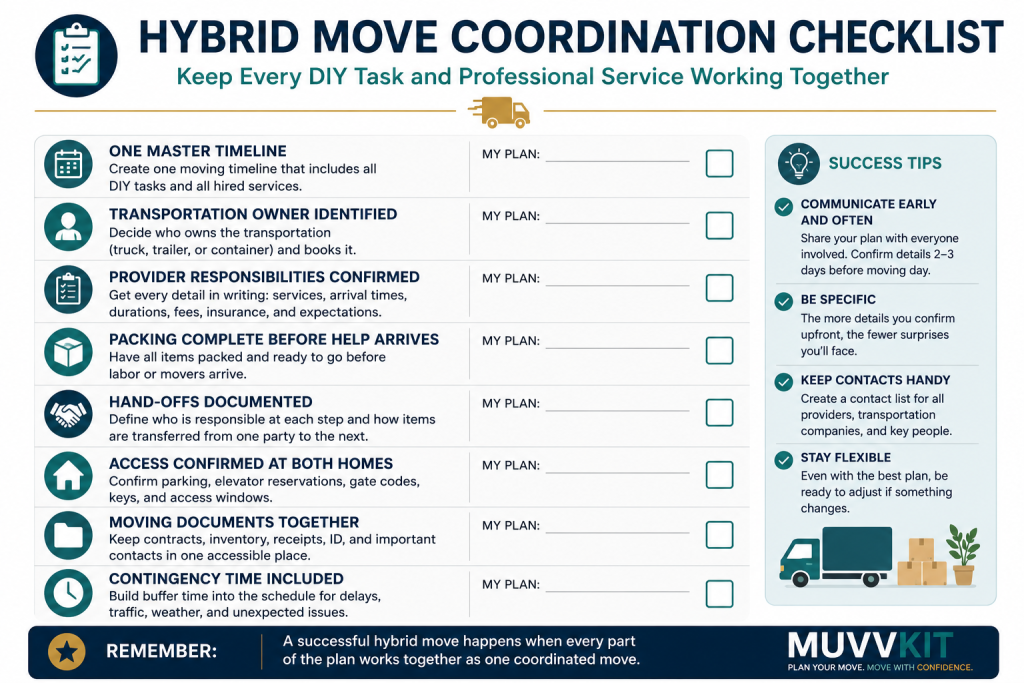
Create one master timeline that shows every dependency. The household must be packed before the loading crew arrives. The vehicle or container must be available before loading begins. Destination access must be available before unloading can happen.
Leave reasonable buffers where one delay could affect the next service. Avoid designing a plan in which a short delay at one stage automatically causes missed labor appointments or an impossible return deadline.
7. Clarify What Each Hired Service Includes
Before booking, confirm the exact scope of each service. For labor-only help, determine whether the workers provide only labor or also bring dollies, straps, blankets, tools, or other equipment. Ask about minimum hours, travel charges, cancellation terms, stairs, heavy items, and tasks the provider will not perform.
If a professional mover will transport household goods interstate, determine whether you are dealing with the mover itself or a broker that arranges transportation. FMCSA distinguishes household-goods movers from brokers, and both interstate movers and brokers are subject to federal registration requirements.
Keep written confirmations for each provider. A hybrid plan is easier to manage when responsibilities are documented rather than based on assumptions made during a phone call.
8. Coordinate Packing With the Transportation Method
Packing decisions affect every hybrid model. If you pack your own boxes, use sturdy containers, close them fully, label them clearly, and keep weights manageable. Separate documents, medications, keys, valuables, chargers, and first-night essentials from the main shipment.
If a professional interstate mover will transport boxes you packed yourself, review the mover’s instructions and documents before packing. Do not assume that owner-packed goods are treated the same as items packed by the mover in every loss or damage situation.
If hired labor will load a rental truck or container, have the packing finished before the appointment. Paying a loading crew to wait while boxes are still being assembled defeats much of the value of hiring help.
9. Plan the Hand-Off Between DIY and Professional Work
Every hybrid move has transition points. A loading crew may finish when the truck doors close. You may then become responsible for securing the vehicle, driving, overnight parking, and arrival timing. At the destination, responsibility may shift again when an unloading crew arrives.
Write down these hand-offs before moving day. Identify who has the keys, who controls the inventory, who has provider contact information, who confirms completion, and who handles unexpected changes.
Keep the documents for every part of the move accessible. That can include rental agreements, mover paperwork, labor confirmations, inventory records, payment information, parking permits, storage information, and destination access instructions.
10. Treat Interstate Professional Transportation Separately
When a household-goods mover transports your belongings across state lines, federal consumer protections may apply to that transportation portion of the move. FMCSA says interstate movers and brokers must meet applicable registration requirements, and consumers should understand the documents and terms associated with the shipment.
For interstate mover service, review the written estimate and the required consumer information. Federal rules also require interstate movers to offer valuation choices known as Full Value Protection and Released Value.
A hybrid arrangement does not erase these distinctions. If you pack some goods yourself but hire an interstate mover for transportation, understand the mover’s responsibilities and your own obligations for the portion governed by the moving agreement.
11. Prepare the Homes for Both DIY Work and Hired Labor
At the origin, clear carrying paths, confirm parking, reserve elevators when required, protect vulnerable surfaces where appropriate, and keep children and pets away from active work areas. Stage boxes so hired labor can begin efficiently.
At the destination, label rooms and decide where furniture should go before unloading begins. Confirm access times, parking, elevators, gates, and any building requirements.
If different crews are working at the two homes, do not assume the destination crew knows how the shipment was loaded. Keep an inventory or room-labeling system that allows the unloading team to work without repeatedly asking where every item belongs.
A hybrid move works best when each handoff has a clear owner. This moving day checklist from loading through final walkthrough can be adapted to separate household tasks from the work assigned to hired help.
12. Run Moving Day From One Command Plan
Hybrid moving day can become confusing because several parties may be involved without one company controlling the entire operation. Use a simple command plan that lists the day’s schedule, providers, contact numbers, addresses, access instructions, payment details, and major responsibilities.
Assign one household decision-maker whenever possible. That person can answer provider questions, approve changes, monitor timing, and keep important documents accessible.
Before each provider leaves, confirm that the agreed work is complete. Check the property, vehicle, container, or shipment as appropriate, and document visible issues while the details are still clear.
Keep Your Hybrid Moving Day Coordinated
A hybrid move can put several schedules, providers, and DIY tasks into the same moving day. Use the MuvvKit Moving Day Command Sheets to keep your timeline, provider contacts, access details, loading information, payments, inventory checks, and other moving-day details organized in one place.
Explore the Moving Day Command Sheets13. Keep Safety Boundaries Clear
Do not use hired labor as a reason to attempt transportation, towing, lifting, or equipment use that is outside your capability. The point of a hybrid move is to place difficult work with appropriate help, not simply to divide every task as cheaply as possible.
Follow the instructions for the rental vehicle, trailer, container, moving equipment, and any professional service you use. Do not overload vehicles or equipment. If an item cannot be moved safely with the people and equipment available, change the plan.
Specialty items may need separate handling. Ask providers in advance whether they accept and are equipped for unusually heavy, fragile, valuable, or restricted items.
14. Review the Move Before the Final Payment and Return
At the end of each hired service, compare the completed work with the agreement. Retain receipts, confirmations, mover documents, rental paperwork, inventories, photographs, and notes about any damage or unresolved issue.
If you rented transportation equipment, follow the provider’s fuel, cleaning, location, and return-time requirements. If a professional mover transported the shipment, retain the bill of lading and other shipment documents while you check the delivery.
Once the transportation and hired services are complete, shift into unpacking and settling in. Keep the hybrid-move records together until the shipment has been reviewed and any follow-up issues are resolved.
Common Hybrid Moving Mistakes to Avoid
Booking services before defining the whole move. Independent bookings can conflict when they are not built around one timeline.
Assuming labor-only help includes transportation or equipment. Confirm exactly what the provider supplies and what remains your responsibility.
Leaving no buffer between services. A late truck, delayed container, or longer loading appointment can affect the next provider.
Comparing only one component of the price. Combine transportation, labor, supplies, equipment, travel, and other expected costs before comparing methods.
Failing to clarify responsibility. Know who controls the shipment, vehicle, inventory, documents, and hand-off at each stage.
Packing while paid loading time is running. Finish the agreed DIY preparation before hired labor arrives.
Treating every provider as the same type of mover. Labor providers, brokers, rental companies, container companies, and household-goods carriers can have different roles and responsibilities.
A Simple Hybrid Moving Planning Sequence
1. Define the complete move from origin to destination.
2. Divide the work into packing, loading, transportation, unloading, storage, and unpacking.
3. Decide which tasks fit your household’s time, skills, equipment, and physical capacity.
4. Identify the tasks you want to hire out.
5. Choose who will control transportation.
6. Build the budget by component and compare the total with other moving methods.
7. Verify providers and document what each service includes.
8. Put all DIY work and hired services on one master timeline.
9. Finish packing and property preparation before paid labor begins.
10. Define each hand-off between your household and hired providers.
11. Run moving day from one schedule and one set of accessible records.
12. Retain receipts, agreements, inventories, and issue documentation after the move.
A hybrid move is successful when the separate pieces operate as one plan. The goal is not to divide the work into the greatest number of services. It is to keep control of the tasks that make sense for your household while placing selected work with appropriate professional help.
Frequently Asked Questions
Is a hybrid move the same as hiring labor-only movers?
No. Labor-only help is one form of hybrid moving, but a hybrid move can combine many arrangements. You might pack yourself and hire a carrier for transportation, rent your own truck and hire loading labor, or combine a container with professional packing for selected items.
Can I pack my own boxes and have professional movers transport them?
Often, yes. This is a common hybrid structure. Ask the mover about packing requirements, prohibited items, valuation, documentation, and how owner-packed boxes are addressed under the mover’s terms.
Can I hire movers only to load or unload a rental truck?
Labor-only providers commonly offer loading and unloading without providing transportation. Confirm what equipment the provider brings, minimum booking time, access requirements, and the tasks included in the service.
Is hybrid moving always cheaper than full-service moving?
No. The total depends on transportation, labor, equipment, supplies, storage, travel, timing, and the amount of work you retain. Compare the complete expected cost of each method rather than a single hourly or rental rate.
Who is responsible for a hybrid move?
Responsibility can change by task. You may control the rental vehicle while a labor provider handles loading, or a professional mover may control the interstate shipment while you handle packing. Document each provider’s scope and understand where your own responsibility begins and ends.
Do FMCSA rules apply to every hybrid move?
No. FMCSA household-goods consumer rules apply to covered interstate transportation by household-goods movers and brokers. A local labor-only service or an intrastate move may fall under different state, local, contractual, or business requirements.
Bring Your Entire Move Together in One Plan
A hybrid move still involves the same major stages of a household move. The MuvvKit Complete Moving Planner Bundle helps you organize your timeline, budget, household details, packing, moving-day tasks, and other important information in one coordinated planning system.
Explore the Complete Moving Planner BundleReferences & Sources
Federal Motor Carrier Safety Administration (FMCSA)
Protect Your Move – https://www.fmcsa.dot.gov/protect-your-move
Rights and Responsibilities – https://www.fmcsa.dot.gov/protect-your-move/consumer-rights
Movers vs. Brokers – https://www.fmcsa.dot.gov/protect-your-move/movers-vs-brokers
What Is an Interstate Move? – https://www.fmcsa.dot.gov/consumer-protection/protect-your-move/are-you-moving/what-interstate-move
Liability & Protection – https://www.fmcsa.dot.gov/consumer-protection/protect-your-move/are-you-moving/liability-protection
Your Rights and Responsibilities When You Move – https://www.fmcsa.dot.gov/sites/fmcsa.dot.gov/files/2023-10/FMCSA_R%26R_Handbook_Web_v1.pdf
U-Haul Moving Help, Moving Help Marketplace 101: How Labor-Only Moving Works – https://www.uhaul.com/Tips/Moving-Help/Moving-Help-Marketplace-101-How-Labor-Only-Moving-Works-36852/
Editorial note: This article provides general educational information for U.S. household moves. Federal interstate household-goods rules do not apply to every moving service or every move. Provider terms and state or local requirements vary, so verify the rules, contracts, and responsibilities that apply to the specific services you use.