Moving Day Documents to Keep Within Reach
Use this moving documents checklist to keep mover paperwork, property-access records, identification, payment information, and condition evidence available from loading through delivery.

Moving day documents should remain accessible from the first arrival check through delivery and final paperwork. If an estimate, access confirmation, inventory, identification card, payment record, or destination instruction is sealed inside a box, it cannot help when a question arises. The practical goal is not to carry every household record. It is to keep the documents needed to authorize, verify, pay for, and complete the move within reach.
The papers needed on moving day are only part of the records you may need throughout the relocation. Use this broader guide to organize the moving documents to keep together before, during, and after a move so important information doesn’t become scattered between boxes, bags, and digital files.
This guide separates shipment documents from the household records that support travel, property access, health needs, and the first night. Requirements differ by move type, provider, contract, property, and location. Federal Motor Carrier Safety Administration guidance discussed here applies specifically to many interstate moves handled by professional household-goods movers; it does not automatically govern DIY, portable-container, rental-truck, local, or intrastate moves.
For the broader sequence around loading, departure, and delivery, use the moving day guide.
Moving Day Document Kit at a Glance
Sort documents by the decision they support. A slim working folder is easier to use than one container filled with every record connected to the household.
For the broader sequence around loading, departure, and delivery, use the moving day guide.
| Document group | What it supports |
| Mover or provider | Estimate, agreement, bill of lading, inventory, valuation selection, contacts, and change records |
| Property and access | Keys, gate or elevator details, parking approval, lease or closing instructions, and handover requirements |
| Identity and travel | Identification, route and lodging confirmations, tickets, vehicle records, and destination contact details |
| Health and household | Medication list, essential care instructions, pet records when needed, and emergency contacts |
| Payment and evidence | Approved payment method, receipts, condition photographs, and records of authorized changes |
Keep Move-Day Details Together
MuvvKit Moving Day Command Sheets provide printable pages for contacts, timing, room directions, final checks, and other details that need to remain accessible throughout the move.
View the Moving Day Command SheetsBuild a Working Paper and Digital System
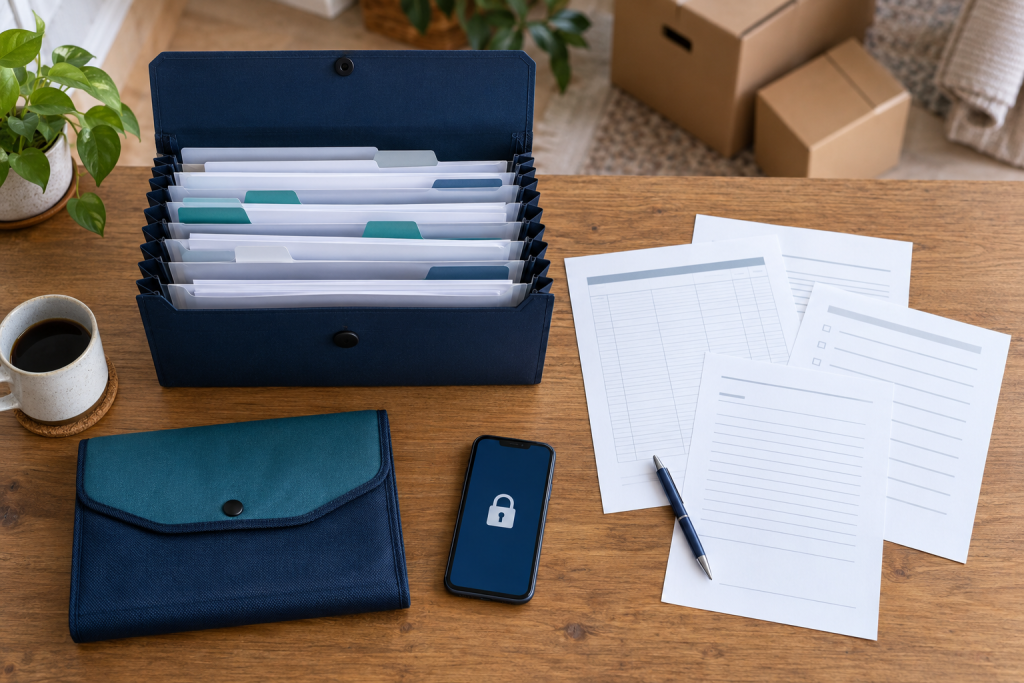
Use one clearly identified folder, expanding file, or document pouch as the paper command file. Keep it with the household decision-maker rather than on a box stack, truck seat, or moving equipment. A second person should know where it is and how to reach the primary contact if the household becomes separated.
Create a Small Working Set
- Place the documents most likely to be reviewed or signed at the front.
- Separate origin, transportation, destination, and personal records with simple tabs or labeled envelopes.
- Carry a pen, a short note sheet, and a way to photograph newly issued paperwork.
- Remove outdated duplicates that could be mistaken for the current version.
- Keep original identity and legal records protected; use copies when an original is not required.
Prepare Digital Copies Without Depending on Them
Save readable scans or photographs of important documents in an appropriately secured location that the authorized household member can reach. Name files consistently and include the date or version when several copies exist. Digital copies can help if paper is misplaced, but they do not replace an original document, signature, or provider-issued form when one is required.
- Download records that may be difficult to reach without internet service.
- Charge the device used to display confirmations and retain a portable battery.
- Protect sensitive files with the device and account security already used by the household.
- Avoid sending identity, financial, medical, or contract records through an insecure shared channel.
Keep Professional Mover Documents Together
For an interstate move handled by a professional household-goods mover, several documents define the shipment, services, charges, condition records, and responsibilities. Read the current versions rather than assuming that an earlier quote controls the move.
Written Estimate and Service Records
Keep the written estimate and any order for service or equivalent service record available. Compare the listed origin, destination, dates, shipment description, requested services, access conditions, and valuation selection with the move that is actually occurring. If the household adds items or requests work, ask how the change will be documented before loading begins.
The current eCFR consumer information for interstate household-goods moves explains that written estimates and related consumer information form part of the interstate moving process. It also states that customers should read documents issued by the mover or broker and notify the mover when shipment details change.
Bill of Lading
The bill of lading is the receipt for the shipment and the transportation contract for an interstate professional move. Check names, addresses, contact information, pickup and delivery terms, payment provisions, and referenced services before signing. Retain the document through delivery, payment, and any unresolved claim or dispute.
The FMCSA moving checklist advises consumers to read the estimate, bill of lading, inventory, and other completed documents before signing. It also advises keeping the bill of lading until the goods are delivered, charges are paid, and any claims are settled.
Inventory and Condition Records
The mover’s inventory can identify articles and record their condition at pickup. Follow the mover as the inventory is prepared when possible, ask about unclear abbreviations or condition descriptions, and resolve questions before signing. Keep your copy available during delivery so missing or damaged items can be compared with the record before final documents are completed.
Valuation and Claims Information
Keep the selected valuation or liability documents, any high-value article forms, insurance records, and the mover’s claims instructions with the shipment paperwork. These records serve different purposes and should not be treated as interchangeable. Review the provider’s current terms and ask a qualified insurance professional when coverage questions extend beyond the moving contract.
FMCSA’s consumer rights and responsibilities page links to the federal handbook that explains interstate moving documents and options if household goods are lost or damaged.
Carry Property and Access Records
The document kit should also support entry, loading, unloading, and property handover. Requirements come from the lease, sale agreement, closing documents, building, parking authority, or property manager rather than from one universal moving rule.
- Origin and destination addresses written in full, including unit numbers and access instructions
- Elevator, loading-dock, parking, gate, security, or certificate-of-insurance confirmations
- Lease, closing, possession, key-release, or property handover instructions needed that day
- Current contact information for building staff, landlords, agents, buyers, sellers, or property representatives
- Required inspection forms, meter-reading directions, key counts, or condition acknowledgments
Keep access codes private and share them only with people who need them. A crew briefing sheet can contain practical directions without exposing unrelated lease, financial, or personal information.
Protect Identity, Travel and Health Information
Identification and travel documents belong with the person who needs them, not in the shipment folder handed around during loading. Check the requirements of the airline, lodging provider, vehicle rental company, border authority, school, medical provider, or other organization involved in the trip. Requirements can change and vary by traveler.
Personal and Travel Records
- Government-issued identification required for travel or transactions
- Tickets, lodging confirmations, route details, vehicle records, and emergency roadside information
- New-home keys, access credentials, destination contact information, and arrival instructions
- Custody, consent, school, or other family records only when the trip or handoff requires them
Health and Pet Information
Carry prescriptions, medication lists, medical-device instructions, insurance information, and essential provider contacts when the household may need them during travel. Keep necessary pet vaccination, boarding, lodging, or transportation records with the person responsible for the animal. Do not place confidential records in an open clipboard or an unattended vehicle.
Keep the overnight bag, medication, travel documents, chargers, and other immediate-use items outside the shipment. The guide to what to pack in a first-night moving essentials kit can help define that separate carry group.
Keep the overnight bag, medication, travel documents, chargers, and other immediate-use items outside the shipment. The guide to what to pack in a first-night moving essentials kit can help define that separate carry group.
Keep Payment and Change Records Available
Verify the payment method and payment point stated in the current agreement. Keep the approved method accessible, but do not expose account details unnecessarily. Save receipts for deposits, rental charges, equipment, fuel, tolls, authorized services, and any payment made during pickup or delivery.
Document Changes as They Happen
- Write down who requested or approved the change and when it occurred.
- Ask for the service, quantity, price, and payment timing in writing.
- Retain the earlier document instead of replacing it without a record of the change.
- Photograph or scan the signed version after each party receives a copy.
- Keep notes factual and separate from assumptions about responsibility.
Do not sign a blank or unread document to save time. If information is incomplete or differs from the agreed plan, stop long enough to understand the document and request correction or clarification from the responsible provider.
Use the Documents During Loading
Keep the folder in one controlled location while the household representative remains available. Do not leave it on a box that may be loaded. Record the driver or crew lead’s name and contact method, and retain any pickup receipt, revised inventory, weight information, equipment record, or other document issued during the handoff.
- Compare newly issued paperwork with the copy retained before loading.
- Resolve inventory questions while the relevant item is still visible.
- Record approved additions, exclusions, access changes, or service changes.
- Keep copies of anything signed and photograph a paper copy if an immediate duplicate is unavailable.
- Place completed pickup documents back in the working folder before the vehicle leaves.
Document control works best when it follows the same sequence as the day. Use the moving day checklist from morning through the final walkthrough to connect paperwork reviews with loading, departure, unloading, and property closeout.
Document control works best when it follows the same sequence as the day. Use the moving day checklist from morning through the final walkthrough to connect paperwork reviews with loading, departure, unloading, and property closeout.
Bring the Same File to Delivery
The document kit remains active at the destination. Use the bill of lading or applicable agreement, inventory, payment terms, destination access details, and condition records while supervising delivery. Follow the provider’s process for noting missing or damaged items and do not rely only on memory.
- Confirm the delivery location and authorized recipient before unloading begins.
- Use the inventory to track articles as the provider’s process requires.
- Record visible loss or damage on the appropriate document before signing when instructed.
- Retain payment receipts, delivery documents, photographs, and written follow-up instructions.
- Store the completed file securely after the immediate move is finished.

Adapt the File for DIY and Hybrid Moves
A DIY move may not use a professional mover’s estimate, bill of lading, or inventory. Substitute the documents that actually control the work: truck or trailer rental agreement, equipment inspection, roadside contact information, fuel terms, driver authorization, storage agreement, helper schedule, and property-access records.
For a hybrid move, separate household responsibilities from each provider’s documents. Keep the container agreement, labor confirmation, rental record, storage terms, and property instructions in distinct sections. A single contact sheet can show who owns each handoff without treating separate companies as one provider.
Most document problems are easier to correct before the crew or helpers arrive. Use what you do the day before moving to complete the final confirmation, access, charging, and no-load tasks.
Common Document Mistakes to Avoid
- Packing the only copy of the agreement, identification, keys, or access confirmation
- Keeping several outdated versions without identifying the current one
- Signing incomplete paperwork without understanding what remains blank
- Leaving sensitive records visible in an unattended vehicle or open common area
- Depending entirely on cloud access when service, battery power, or account access may be limited
- Failing to retain receipts or written authorization for changed services
- Separating the inventory from the condition photographs and delivery records it supports
- Discarding the bill of lading or provider documents before delivery and possible claims are complete
Most document problems are easier to correct before the crew or helpers arrive. Use what to do the day before moving to complete the final confirmation, access, charging, and no-load tasks.
Moving Day Documents FAQs
What moving documents should I keep with me?
Keep the current provider agreement, estimate when applicable, bill of lading, inventory, valuation or insurance records, payment information, receipts, access confirmations, identification, travel details, essential health records, keys, and emergency contacts that the household may need during the move. The exact set depends on the move method and agreements.
What is the most important document for a professional interstate move?
No single document replaces the others. The written estimate describes expected charges and services, the bill of lading serves as the transportation contract and shipment receipt, and the inventory records articles and condition. Keep the complete current set together.
Can I use digital copies of moving documents?
Digital copies are useful backups and may be accepted for some purposes, but they do not automatically replace original identification, signatures, contracts, or provider-issued forms. Confirm what each organization requires and keep critical documents available offline when practical.
Should I keep original personal documents in the moving folder?
Carry originals only when the move, travel, transaction, or household need requires them. Protect passports, birth certificates, financial records, medical information, and other sensitive documents separately from working paperwork that may be shown to several people.
How long should I keep the bill of lading?
FMCSA advises consumers on interstate professional moves to retain the bill of lading until the goods are delivered, the charges are paid, and any claims are settled. Other records may have different retention needs based on contracts, taxes, insurance, property matters, or legal advice.
What documents do I need for a DIY move?
A DIY file commonly includes the truck or trailer rental agreement, driver authorization, equipment inspection, roadside contact information, fuel and return terms, storage agreement if used, route and lodging details, property access records, payment receipts, and an independent household inventory.
What should I do if paperwork changes on moving day?
Ask for the change in writing, compare it with the earlier document, confirm the service and price, and retain copies of both versions. Do not sign a blank or unread document. For a dispute or legal question, contact the responsible regulator, consumer agency, or qualified professional.
Organize the Rest of Your Move
The Complete Moving Planner Bundle brings timelines, packing plans, budget pages, mover information, and moving-day details into one coordinated planning system.
View the Complete Moving Planner BundleExplore the complete Manage Moving Day resource collection for guidance on preparation, loading, delivery, final walkthroughs, and move-day closeout.
References and Resources
Editorial Note: These sources were selected because they are primary federal resources for interstate professional household-goods moves. The moving-day working folder, paper-and-digital backup method, tab structure, and document handoff sequence are MuvvKit organizational frameworks rather than federal requirements. Contracts, forms, state rules, identification requirements, payment terms, and provider procedures can change. Verify current requirements with the mover, rental or container company, insurer, property representative, transportation provider, government agency, or qualified professional responsible for the specific transaction.